Hutchinson Through Local Eyes
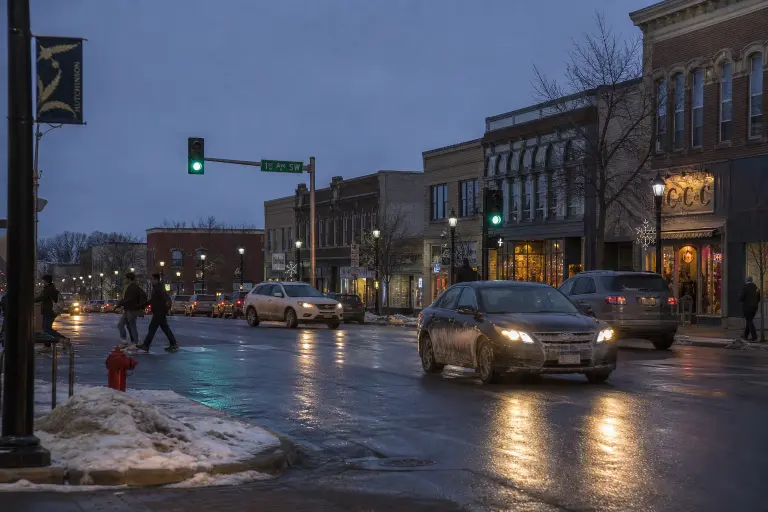
By five o'clock on a winter weekday, Hutchinson starts to reveal itself in headlights. Cars roll past Main Street storefronts with salt crusted along the doors. A nurse leaves Hutchinson Health with a tired face and a lunch bag that never made it back into the fridge. A hockey parent pulls into Burich Arena carrying skates, a water bottle, and the private hope that practice will end on time.
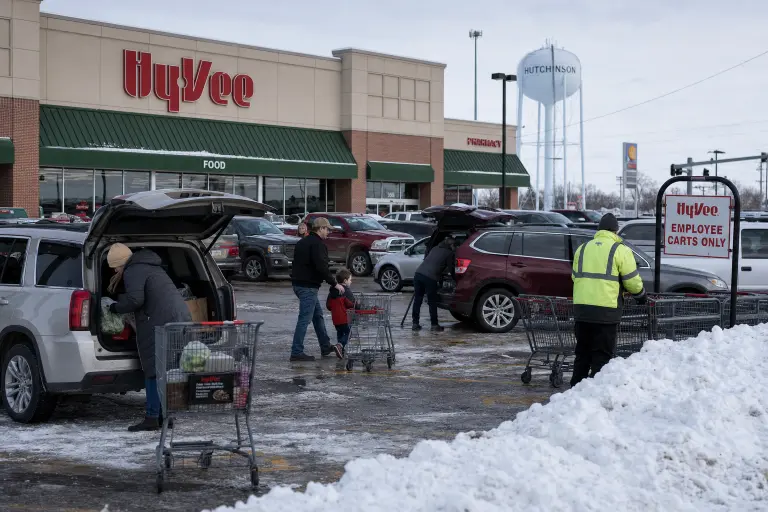
At Cash Wise, the parking lot is busy in the ordinary way that says more about a town than any slogan ever could. People still need milk, prescriptions, dog food, birthday cupcakes, and something easy for supper.
This is not a town you understand by driving through once on Highway 7 or Highway 15. Hutchinson is a place of repeated errands, familiar turns, and small recognitions. You learn it by knowing which lots are full, which roads slow down at the wrong hour, and which complaints people repeat because they are really expressions of belonging.
The town is not frozen in time. It has changed more than people admit. But it still has a rhythm you can feel if you stay long enough.
Why does Hutchinson feel familiar even when it is changing?
Because it still has two versions of itself: the town you see from the road, and the town people actually use. One is made of signs and traffic. The other is made of habits, memory, and the long repetition of ordinary life.
From the road, it looks one way. From inside, it looks another.
From the road, you notice Walmart, Menards, fast food signs, the larger parking lots, the places built for speed. You notice traffic stacking up near the commercial strips when school is out or when everyone seems to be crossing town at the same time. You notice the pickup trucks in winter, the minivans with sports stickers, the commuter cars pointed toward the Cities before sunrise.
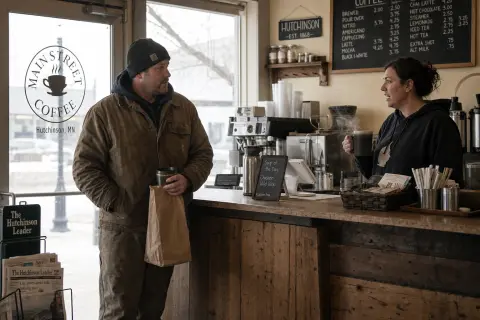
But the lived town is more specific. It is a retired farmer taking longer than necessary to buy hardware because the conversation is part of the errand. It is a high school student walking downtown after class with no particular destination, half in the physical town and half in whatever is happening on a phone. It is a local business owner sweeping near the doorway before opening, watching foot traffic like weather.
It is also a factory worker stopping for gas and a frozen pizza after a shift, too tired to cook but still making it to a kid's game. In places like Hutchinson, the day is not measured by headlines. It is measured by what gets done between one errand and the next.
The river is not just scenery here
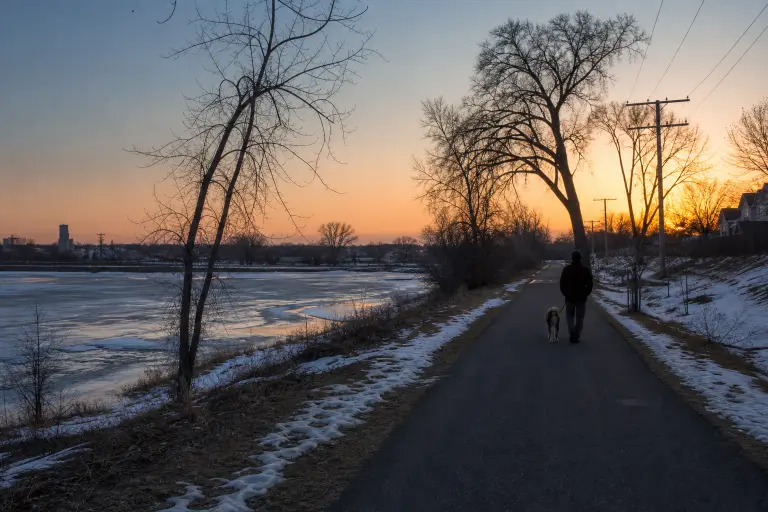
The Crow River gives Hutchinson a kind of center that is not always obvious. It bends through memory as much as geography. People walk near it, fish near it, take prom photos near it, and remember flood years by what the water almost touched.
Masonic West River Park is where the town exhales, especially when the weather finally loosens its grip. The Luce Line Trail carries bikes, strollers, runners, and older couples who walk the same route often enough to know which branches fall after a storm.
In July, Hutchinson opens outward. In January, it contracts.
Seasonal shift
Summer is when people linger near Library Square, the river, downtown, and the fairgrounds. Winter is when the town becomes a system of heated interiors: schools, churches, kitchens, break rooms, Burich Arena, the grocery store, the bar, the clinic, the garage.
Snowbanks in February narrow the edges of everything. People talk about plowing, the cold, the wind, and how long winter has been, even in winters that are normal. This is not small talk. It is civic weather reporting.
What changed on Main Street?
Main Street in Hutchinson is not a museum piece, though people sometimes talk about it that way. Downtown Hutchinson has lost things, gained things, and learned to survive without being the only place people shop.
Older residents remember buildings by what they used to be. Someone will point and say, that was the place where we bought shoes, or that used to be where everybody went before Christmas, or your aunt worked there for a while. The sentence usually begins with memory and ends with a shrug. Towns keep old maps in people's heads long after signs come down.
Downtown has had to become less about necessity and more about experience, service, habit, and identity. That is a hard transition. Amazon changed the way people buy objects. Walmart changed price expectations. Menards changed the weekend project run. Digital wallets and delivery habits changed patience. People can compare prices from a parking lot now.
They can buy a phone charger without talking to anyone. They can order shoes at midnight and send them back without apology.
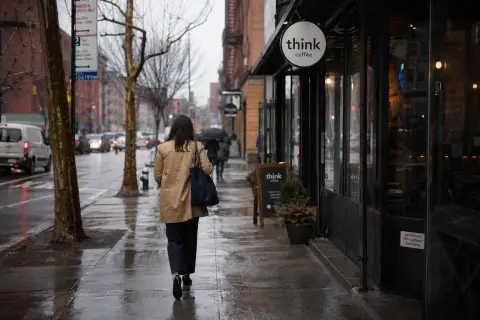
So the businesses that survive downtown tend to do something the internet cannot fully flatten. They know names. They create routine. They offer taste, repair, advice, a reason to browse, or a feeling people cannot get from a cardboard box on a porch.
Bobbing Bobber Brewing Company
Not just about beer. About where adults can meet without it being a wedding, a school event, or a fundraiser.
Main Street Sports Bar
A different kind of continuity: games on screens, people stopping in after work, and conversations that start with sports but move toward snow, taxes, kids, or a project that needs help.
Library Square says a lot about the town
Library Square remains one of the clearest signs that Hutchinson still believes in public life. It is not fancy in the way big-city planners use the word. It is useful, visible, shared. The Veterans Memorial nearby gives the center of town a seriousness that balances the concerts, parades, and casual wandering. It reminds people that community is not only events and shopping. It is names, service, grief, and gratitude made permanent in stone.
Why are some parking lots always busy?
If you want to understand modern Hutchinson, watch the parking lots.
Cash Wise is busy because groceries remain one of the last democratic errands. Everybody eats. Everybody forgets something. Everybody runs into somebody in the produce section or near the bakery. Walmart is busy because convenience wins more often than people like to admit. Menards is busy because houses age, basements leak, decks need boards, and Minnesotans believe a Saturday can be redeemed by buying screws, mulch, furnace filters, and one thing they did not come for.
Hutchinson Mall tells a more complicated story. Malls everywhere carry the evidence of changing habits, and Hutchinson is no different. People remember when indoor retail felt like the future, when teenagers had fewer digital places to disappear into, when a mall could be a social plan by itself. Now the mall is part useful, part nostalgic, part question mark.
Some stores hang on because they still solve real problems. Others struggle because browsing has moved to screens and impulse buying has been absorbed by algorithmic recommendations. Still, local people do not simply abandon places because trends say they should. They use them differently.
A young family
Stops because it is indoors in February and the kids need to move.
An older resident
Goes because it is familiar.
A teenager
Passes through without the same sense of possibility their parents once felt there.
Where does the town gather without calling it gathering?
Friday night football brings the town into one frame: students in clusters, parents in jackets, grandparents wrapped in blankets, younger kids running around with more energy than attention. The game matters, but so does being seen there. High school sports still create a shared calendar in a world where almost everything else has fragmented.
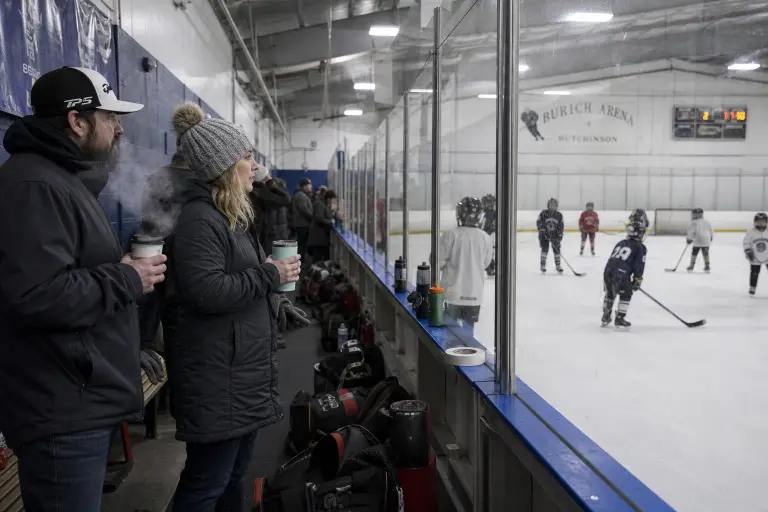
Hockey season has its own tribe. At Burich Arena, the cold is different from outdoor cold. It gets into your hands through the coffee cup. Hockey parents become logistics experts, budget managers, chauffeurs, and emotional shock absorbers. They know early mornings, hotel weekends, missing gloves, sharpened skates, and the strange pride of watching a kid learn discipline on ice.
The McLeod County Fair is another kind of gathering, older and earthier. It ties Hutchinson to farms and 4-H families, to machinery, animals, weather, and the stubborn fact that food begins somewhere other than a store shelf. Tractor traffic during harvest season still reminds drivers that the town is not separate from the land around it.
People may complain when they get stuck behind equipment, but the complaint is usually softened by recognition. Around here, harvest has the right of way in a moral sense, even when it slows the road.
There are informal gathering points too. Dairy Queen on a summer night. The bait shop counter where fishing reports become half science, half folklore. A table at Main Street Sports Bar. A bench near the river. The waiting area at Hutchinson Health. The school pickup line, where parents sit in vehicles answering texts, checking schedules, and watching for children who emerge carrying backpacks, instruments, sports bags, and the moods of the day.
Who lives the everyday Hutchinson story?
The retired farmer
Still watches fields even if he no longer works them the same way. He knows rain by smell and distrusts most talk that comes too quickly.
The nurse
Moves between professional calm and private exhaustion. In a town this size, health care workers often treat people they will later see at the grocery store.
The local business owner
Competes with Amazon by offering trust, speed, service, and presence. One bad winter can hurt sales, one road project can change foot traffic, and one loyal customer can keep a place alive.
The factory worker
Part of a long Hutchinson tradition of making things. The town depends on people who work shifts, fix machines, run lines, manage inventory, and come home with sore feet.
The commuter or remote worker
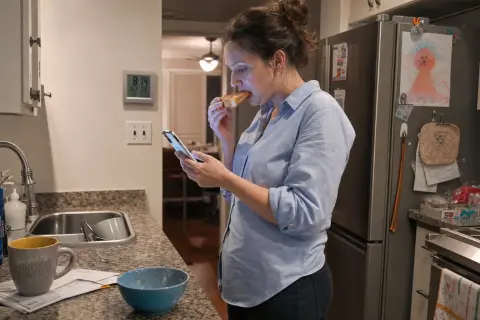
Lives in Hutchinson for space, schools, family, or affordability, but is tied economically to somewhere else. Remote work has changed that person's day and maybe even their reasons for staying.
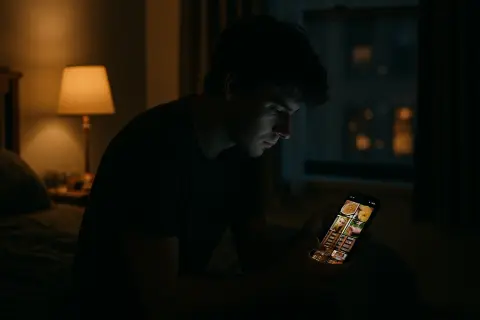
Then there is the high school student, whose Hutchinson is both smaller and larger than it used to be. Smaller because phones make national culture immediate. Larger because a kid can grow up here while watching lives unfold in Minneapolis, Los Angeles, Seoul, or anywhere else a feed leads. Younger people use the town differently. They do not always inherit the same loyalties to stores, churches, clubs, or downtown habits. But they still inherit the weather, the school calendar, the river, the games, and the desire to leave mixed with the possibility of returning.
What has Hutchinson gained, and what has it lost?
Hutchinson has gained convenience. It has gained more ways to eat, shop, work, and connect. It has gained trails, gathering spaces, new businesses, better access to goods, and a broader sense of what a small city can be. Ridgewater College adds another layer, bringing students, training, and the practical hope that people can build careers without disappearing into a metro area.
The town has gained newcomers who bring different expectations. Some want walkability. Some want acreage. Some want good internet more than a formal living room. Some are escaping larger cities not because they dislike culture, but because they are tired of cost, traffic, and anonymity.
But Hutchinson has lost things too. It has lost some of the old certainty about what downtown was for. It has lost stores that once served as landmarks in people's personal histories. It has lost a little of the shared attention that came when fewer screens divided the day. It has lost the ease of assuming that young people will stay, or that institutions will remain strong just because they have always been there.
People complain about traffic on Main Street, about winter parking, about empty storefronts, about prices, about how hard it is to find workers, about how kids are always on phones, about how nothing stays the same and somehow also how nothing new ever happens.
These contradictions are not hypocrisy. They are what it sounds like when a community is trying to adapt without losing itself.
What could Hutchinson become in 40 or 50 years?
By the 2060s or 2070s, Hutchinson may look less like a small city orbiting bigger economies and more like a self-contained regional hub for people who want human-scale life with digital access.
If remote work continues, the daily commute may become less central. More people could choose Hutchinson because they can work from anywhere but do not want to live anywhere. That could strengthen downtown if workers spend more weekdays locally. Coffee, lunch, child care, fitness, health care, coworking, repair shops, and evening events could matter more.
Or it could go the other way. If online life absorbs even more errands, downtowns everywhere may have to fight harder for relevance. The winners will be places that offer what screens cannot: trust, touch, memory, expertise, and the simple pleasure of being among people without needing a formal reason.
Hutchinson Mall may become something locals do not currently imagine as a mall at all. Across the country, retail buildings are being reconsidered as clinics, classrooms, small warehouses, indoor recreation, senior services, housing, and hybrid community spaces. In 50 years, the question may not be whether the mall survived as retail, but whether the building adapted to what people actually needed.
The future will not arrive as flying cars over the Crow River. It will arrive as new habits attached to old places.
A retired farmer's grandson
May run planting equipment guided by systems more precise than anything his grandparents imagined, then meet friends downtown for trivia.
A nurse
May use AI diagnostics at Hutchinson Health but still rely on the human skill of sitting beside a scared family.
A high school student
May take college credits through Ridgewater, work remotely for a company in another state, and still come back for Friday night football because identity is not entirely efficient.
That may be Hutchinson's best chance: not resisting change, but insisting that change still pass through real life.
Why does community matter more when everything is digital?
The more life moves through screens, the more physical places carry emotional weight. A town like Hutchinson can seem ordinary until you realize ordinary is exactly what people are afraid of losing.
The line at Dairy Queen. The sound of skates at Burich Arena. The fairgrounds at dusk. The Crow River after rain. Cash Wise before a storm. Menards on a Saturday morning. Veterans Memorial on a quiet afternoon. Library Square during a summer concert. Tractor traffic that makes you late but reminds you where you are.
These are not attractions. They are anchors.
The quiet truth
Hutchinson is not perfect, and locals would be the first to say so. It can be too small when privacy is wanted, too spread out when walking would be nicer, too cautious when new ideas need room, and too quick to remember what a building used to be. But it is also generous in ways that do not announce themselves.
People show up. They buy raffle tickets. They coach. They shovel. They notice when a business closes. They remember whose kid is graduating. They argue about change and then stand next to each other at the same event.
To know Hutchinson is to understand that a town is not a brand. It is a long conversation between what people need, what they miss, what they tolerate, and what they protect.
Common questions about Hutchinson, Minnesota
The town after the errand
At night, Hutchinson settles in pieces. The grocery carts are pushed back into rows. The last practices end at Burich Arena. A few people remain downtown longer than planned. Snowplows scrape along familiar routes. Somewhere near the river, a dog pulls its owner toward a smell only it understands. Out by the fairgrounds, the empty space waits for summer noise.
Tomorrow, Main Street will fill again. Someone will stop at Cash Wise for two things and leave with six. Someone will complain about the backup near the intersection. Someone will run into an old teacher, a former teammate, a cousin's friend, a nurse from the clinic, or the person who knows exactly which lure has been working.
That is Hutchinson. Not a postcard. Not a pitch. A place where the future keeps arriving in ordinary clothes, and people keep deciding, day by day, what is worth carrying forward.