The Quiet Return of Places That Know Your Name
The coffee shop is open before the sky has made up its mind. A man in a Carhartt jacket holds the door with his elbow because both hands are full: one travel mug, one paper bag, one phone he is not looking at. Behind the counter, someone already knows his order. Not because an app predicted it. Because he has stood in this same line enough times for a human being to remember.
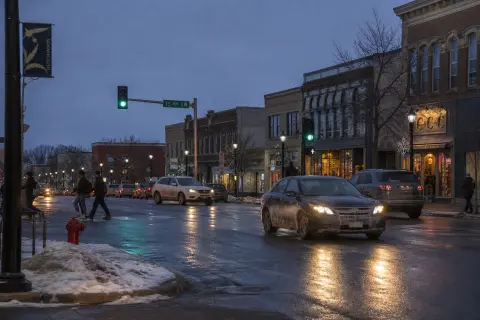
Outside, Hutchinson is still half-asleep. A delivery truck sighs near a back entrance. A few headlights move along Main Street. Somewhere, a parent is coaxing a child into shoes. The day has not become efficient yet.
That may be why it feels so valuable.
Across America, towns like Hutchinson, Minnesota are beginning to resonate again, not as escape fantasies or postcard versions of the past, but as places that answer a very modern hunger. People are tired of being processed. They are tired of passwords, dashboards, delivery windows, automated menus, anonymous apartment corridors, and cities where the cost of being near opportunity can feel like a monthly punishment.
What people are really looking for
Not just small-town life. A life where the physical world still recognizes you.
Why does a place like Hutchinson feel different now?
For a long time, many Americans were trained to see bigger as better. Bigger cities meant better careers. Bigger stores meant lower prices. Bigger platforms meant more choice. Bigger networks meant more reach. The modern promise was expansion: more options, more speed, more access, more everything.
Then, quietly, more began to feel like too much.
People can now order toothpaste at midnight, stream any song from childhood, join a meeting from a kitchen table, and pay for groceries without speaking to another person. Convenience did what it promised. It removed friction. But it also removed a surprising number of small human encounters that once gave shape to a day.
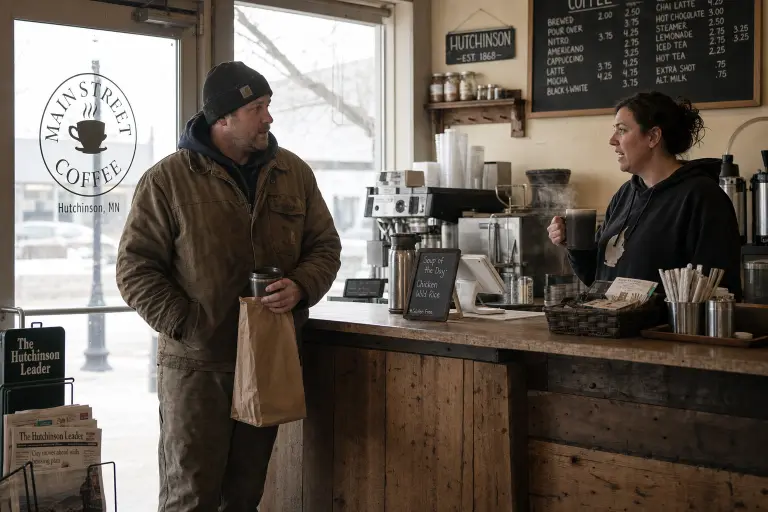
In a town like Hutchinson, friction still exists in ways that can feel almost relieving. You may need to park and walk. You may run into someone you know when you are not prepared to be seen. You may have to wait behind two people who are talking to the cashier about a school fundraiser, a snowstorm, a niece's wedding, a road closure, a sick dog.
For someone in a hurry, this can feel inefficient.
For someone who has spent years inside apps and traffic and inboxes, it can feel like oxygen.
There is a difference between being served and being recognized.
Much of modern life is very good at the first and increasingly poor at the second.
The emotional weight of familiar faces
In a large city, anonymity can be freedom. No one asks where you have been. No one notices what you bought. No one remembers who you used to date or how your family is doing. For some people, especially younger adults leaving home, that invisibility can feel like becoming yourself.
But anonymity has a cost when it becomes the default condition of daily life.
Everyday signs of the shift
- Self-checkout lanes that feel fast but strangely lonely
- Packages arriving from warehouses you will never see
- Digital wallets making payment nearly invisible
- AI assistants beginning to schedule, summarize, and respond
There is a particular loneliness in being surrounded by people who have no reason to remember you. You can live above hundreds of neighbors and never know the sound of their names. You can pass through a self-checkout lane, tap a card, grab a bag, and leave no trace except a transaction record. You can receive packages from warehouses you will never see, packed by people whose names you will never know, delivered to a porch by someone already being timed.
None of this is evil. Most of it is useful. That is what makes the shift so complicated.
Amazon expectations have changed the rhythm of shopping. Delivery apps have changed the meaning of dinner. Digital wallets have made payment nearly invisible. AI assistants are beginning to schedule, summarize, recommend, and respond. Life is smoother in countless ways. Yet many people are discovering that a smooth life can also become a thin one.
How remote work changed the map of desire
Remote work did not just move jobs out of offices. It moved imagination out of a few expensive zip codes.
When workers realized that at least some careers could happen from a spare bedroom, a converted porch, or a desk near the laundry room, the old geography of ambition weakened. The question changed from, Where do I need to be? to, What kind of life can I build if I do not have to be there every day?
That question has carried people toward places they might once have dismissed.
What towns like Hutchinson offer
Enough infrastructure to function.
Enough quiet to breathe.
Enough community to feel located.
Schools and clinics, coffee shops and parks, restaurants and repair places, big-box convenience and independent storefronts.
For families, the appeal is often practical at first. Housing costs. Space. Schools. Safety. A shorter errand loop. Grandparents nearby. A childhood where kids might bike to a friend's house instead of being scheduled into every movement.
But beneath the practical reasons is an emotional one. People want their days to feel less extractive.
In larger metro areas, the basics can become draining: parking, rent, noise, commute time, childcare logistics, the constant math of whether convenience is worth the fee. Remote work exposed the bargain. If you no longer need the city every weekday, why pay for its exhaustion every day?
This does not mean everyone wants to leave urban life. Cities remain engines of culture, reinvention, density, and possibility. But the old assumption that serious life happens only in major cities has softened. A person can now want ambition and a quieter street. They can want good coffee and visible stars. They can want broadband and a neighbor who waves.
The new dream is not anti-modern.
It is selectively modern.
What younger generations are rediscovering in physical places
It would be easy to assume that younger people, raised on phones, would be least interested in physical community. But the opposite is becoming visible in small ways.
They are collecting vinyl records while streaming music. They are buying secondhand clothes in local resale shops after scrolling trend videos. They are taking film photos and posting them digitally. They are turning coffee shops into third places because home is crowded, work is remote, and online spaces have become noisy with performance.
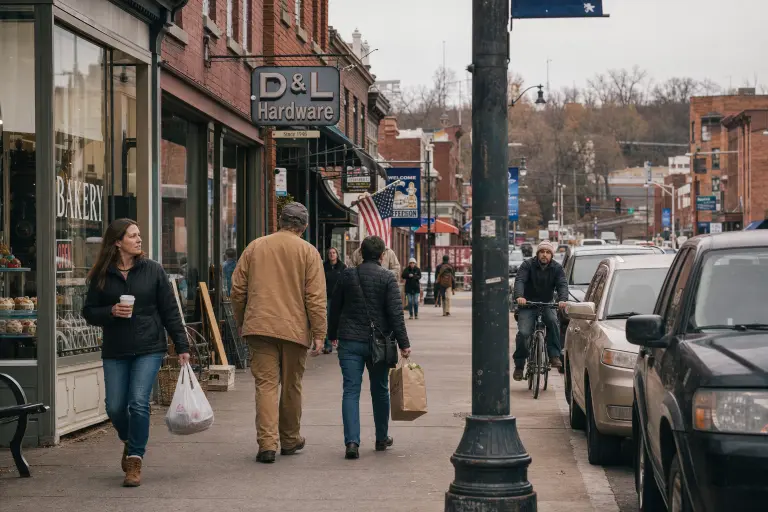
The physical world gives them something the algorithm cannot fully replicate: atmosphere.
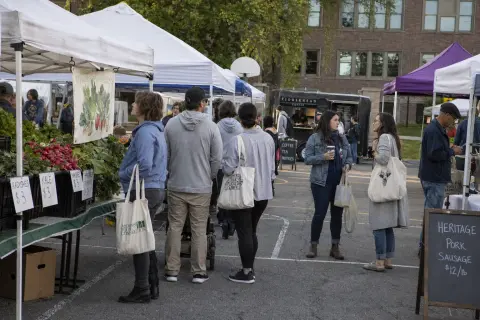
A downtown event in Hutchinson might look ordinary from a distance. Families walking with paper cups. Teenagers drifting in clusters. A stroller wedged near a curb. A band under a tent. Someone's grandmother sitting in a folding chair she brought from home. A local business with its door propped open. Children wanting snacks. Parents pretending not to be tired. People stopping every few feet because they recognize someone.
To a person trained by the internet, this can feel almost strange. Nothing is optimized. There is no personalized feed. You do not choose exactly who appears. You cannot skip the awkward conversation or mute the man telling a long story. You are simply there, in the same weather, under the same sky, part of a scene that does not revolve around you.
That may be precisely the point.
A place becomes real when your memories start sticking to it.
The quiet power of dusk in a neighborhood
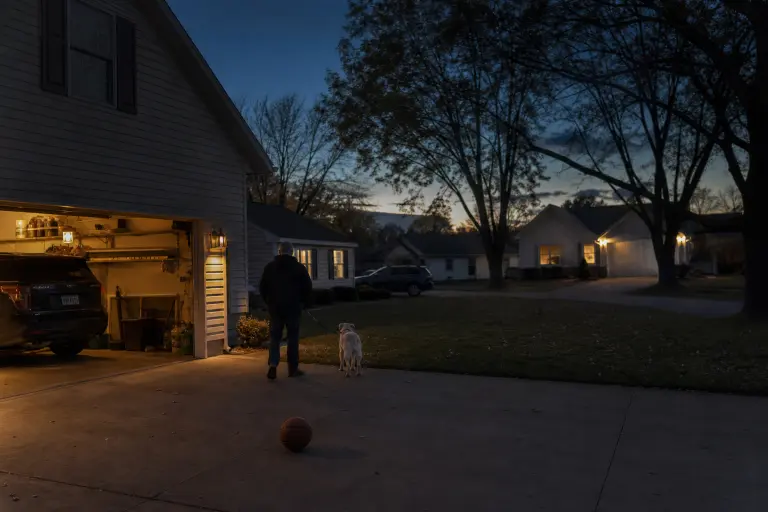
In Hutchinson, it might be dusk on a mild evening. Lawns darken. Garage doors close. A basketball bounces somewhere out of sight. A dog pulls at a leash. Dinner smells slip out before doors shut. The last light catches the roofs and the tops of trees. A cyclist moves past slowly enough to nod.
Nothing remarkable happens.
That is the remarkable part.
So much of modern life is designed to stimulate. Screens glow. Feeds refresh. Notifications arrive with tiny demands. Even leisure can become another arena of choice, comparison, and tracking. Did you watch the right show? Buy the right thing? Visit the right place? Improve yourself efficiently enough?
A quiet neighborhood at dusk offers a different kind of value. It does not ask to be rated. It does not update. It does not care if you photograph it.
For people burned out by larger cities, this ordinariness can feel almost luxurious. Not luxury as status, but luxury as relief. The ability to hear insects. The ability to take a walk without strategizing. The ability to know which house decorates early for Halloween, which corner gets icy first, which neighbor mows on Friday, which dog barks at everyone except children.
These details are small, but they accumulate into belonging.
Belonging is not always dramatic. Often it is simply knowing where you are without needing a map.
When convenience stops being enough
The great promise of convenience culture was that people could get time back. Order online. Skip the line. Automate the bill. Subscribe and save. Let the device remember. Let the algorithm suggest.
But the time returned often gets swallowed by something else: more work, more scrolling, more decisions, more fatigue.
Subscription fatigue is one of the clearest signals. People liked the ease until every part of life became a recurring payment. Streaming, software, groceries, pet food, fitness, cloud storage, meal kits, security cameras, kids' learning apps. Convenience began to feel less like freedom and more like a quiet leak in the household budget.
Self-checkout backlash tells another part of the story. Many shoppers appreciate speed. But many also resent doing unpaid labor while being watched by machines that suspect them of stealing bananas. The technology works well enough to spread, but not always warmly enough to satisfy.
What a local purchase still carries
Context.
A person who may ask what you are fixing.
An owner who sponsors a youth team.
An employee who lives down the street.
A window display changed by hand because somebody cared enough to do it.
This is where towns like Hutchinson gain emotional meaning. They remind people that efficiency is not the only measure of a good life.
The value is not just what you buy. It is the feeling that your purchase enters a human circuit instead of disappearing into a vast system.
This matters more as more of life becomes abstract. Work is abstracted into platforms. Money into numbers on a screen. Friendship into messages. Shopping into boxes. Entertainment into feeds. Even identity becomes something managed across profiles.
Local life returns texture.
What could towns like Hutchinson represent 50 years from now?
Imagine the year 2075, not as a chrome fantasy, but as an extension of what is already happening.
AI systems manage calendars, transportation, household inventory, medical reminders, school tutoring, insurance forms, tax filings, and the thousand bits of coordination that used to exhaust families. Many homes reorder basics before anyone notices they are low. Autonomous delivery pods move through neighborhoods with quiet precision. Virtual workspaces are convincing enough that colleagues in different states feel almost present. Personalized media can generate a show, a tutor, a coach, or a companion on demand.
Life is astonishingly convenient.
And because of that, physical community may become more precious, not less.
The premium good may not be speed. It may be presence.
In such a future, towns like Hutchinson could represent something rare: places where unplanned human contact still has social value. Where people gather not because they must, but because they have learned that a fully automated life can become emotionally airless. Where downtown is not merely a retail zone, but a civic living room. Where the farmers market, the library, the coffee shop, the park, the school concert, and the winter parade become forms of cultural infrastructure as important as broadband.
We already see hints of this. People pay more for handmade goods after buying mass-produced ones. They seek live concerts after endless streaming. They attend local markets after years of doorstep delivery. They choose restaurants not only for food, but for the feeling of being somewhere. In an automated future, the value of these experiences could intensify.
Physical community may become a kind of emotional refuge.
Not because technology fails, but because it succeeds too well.
Will slower towns become refuges from automated life?
The word slow can be misleading. Small towns are not necessarily simple, easy, or untouched by stress. People in places like Hutchinson work hard. They worry about bills, health, weather, schools, jobs, childcare, addiction, aging parents, and whether their children will stay or leave. Community can comfort, but it can also watch too closely. Being known is not always gentle.
That honesty matters. The renewed interest in towns like Hutchinson should not flatten them into lifestyle products.
Still, slower places may offer a counterweight to the acceleration around them. They may preserve practices that become harder to find elsewhere: greeting by name, lingering after a purchase, showing up in person, knowing local history, repairing instead of replacing, caring about the fate of a storefront because it affects the emotional shape of the street.
Why people may choose these places
- Affordability
- Climate stability or regional food systems
- Remote work flexibility
- Children knowing elders who are not relatives
- Face-to-face social life that still feels real
In 40 or 50 years, people may intentionally choose towns where the human layer is still intact. Not everyone, and not for the same reasons. Some will come for affordability. Some for climate stability or regional food systems. Some because remote work became ambient and location became flexible. Some because they want their children to know elders who are not relatives. Some because, after decades of machine mediation, they crave places where social life still happens face to face.
The most desirable communities may be those that blend technology with local trust. AI may help manage city services, energy use, public transit, health access, and small business logistics. But the heart of the place will remain stubbornly human: the coach who remembers a kid's confidence, the barista who notices someone has gone quiet, the shop owner who gives directions, the neighbor who brings a snowblower over before being asked.
A town's future strength may depend on whether it can modernize without becoming anonymous.
Will physical community become premium?
In many ways, it already has.
Walkable neighborhoods command attention because they offer something people lost to car dependency and screen life: casual proximity. Local businesses attract loyalty because they make commerce feel relational. Community events matter because they create shared memory in a fragmented media culture. Even a bench on a pleasant block can become valuable if it invites people to sit without buying anything.
The premium future may not look like gated luxury. It may look like ordinary access to ordinary togetherness.
These are not glamorous amenities. They are the background conditions of a humane life.
As digital convenience grows, the ability to participate in a real place may become a marker of wealth, planning, and civic care. Communities that protect their downtowns, support local businesses, build housing thoughtfully, maintain parks, and make walking pleasant may offer residents something algorithms cannot ship: a sense of being held by place.
Why being known still matters
To be known is to accept a little vulnerability. Someone may notice your routines. Someone may ask where you have been. Someone may remember your grief, your divorce, your new job, your child's graduation, your usual order.
Modern life often sells privacy as control, and control is genuinely important. But total anonymity can become its own kind of exposure. If no one knows you, no one notices when you disappear.
Towns like Hutchinson resonate because they suggest another balance. You can have modern tools without surrendering the comfort of recognition. You can use online ordering and still value the person at the counter. You can work remotely for a company hundreds of miles away and still care about the downtown outside your window. You can live in a digital century and still want a place where your footsteps matter.
The American longing now is not simply for the past. The past had exclusions, limits, hardships, and silences that should not be romanticized. The longing is for continuity in a time of constant update. For rootedness without stagnation. For community without suffocation. For convenience without disappearance.
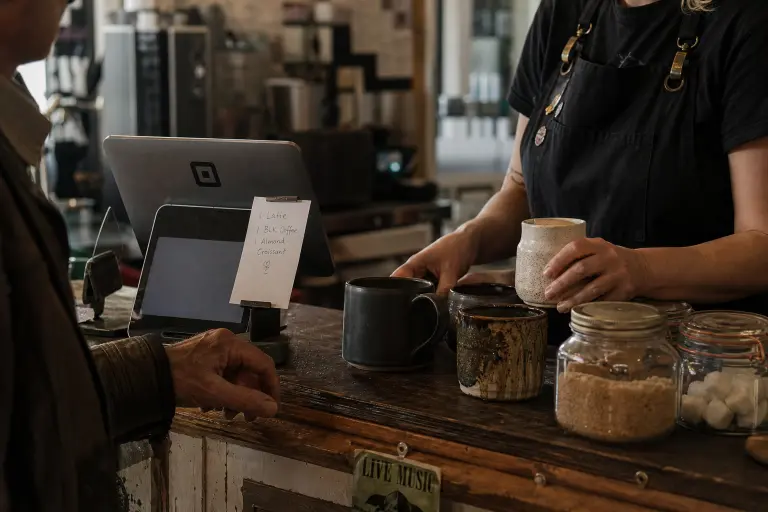
At the coffee shop, the morning line keeps moving. Someone laughs louder than necessary. Someone checks the weather. Someone taps a phone to pay. The machine accepts it instantly, but the moment does not end there.
The person behind the counter says, See you tomorrow.
And that small sentence carries more weight than it used to.