The Age of Replaceable Love
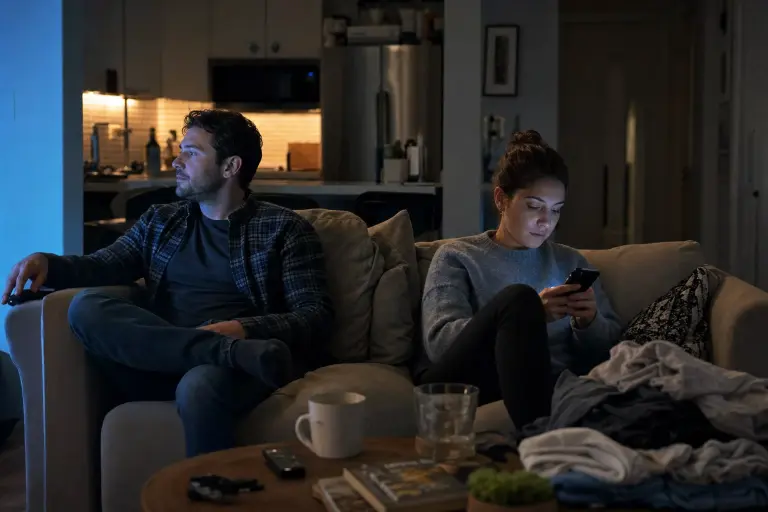
They are sitting on the same couch, but not really together. One end glows blue from Netflix, the other flickers with TikTok. No shouting. No slammed door. Just two people breathing in the same room, quietly elsewhere.
Stopping the episode would mean admitting no one is watching. Looking up from the feed would mean noticing the distance. So the room keeps its peace, and the peace is thin.
Fifty years ago, a couple in that same silence had far fewer exits. Fewer private worlds inside a screen. Fewer people to compare against. Fewer ways to imagine starting over. They also had more pressure to stay -- money, religion, children, shame, neighbors, parents, habit. Not necessarily more love. Just fewer doors.
That is what makes the modern question so uneasy. If relationships now live in the same world as streaming subscriptions, next-day delivery, swipe-right dating, personalized recommendations, and constant upgrades, was it inevitable that commitment would start to feel different too?
Why commitment feels fragile now
Because leaving used to be a crisis. Now it can feel like a preference, and preferences are easier to revise.
Why does commitment feel more fragile now?
For most of human history, leaving a relationship was not just emotional. It was practical. Marriage was tied to land, children, labor, survival, family alliances, religious duty, and basic economic security. A husband and wife were not only companions. They were co-workers, co-parents, legal partners, and often each other's only acceptable future.
That structure held many people in place. Sometimes it protected families. Sometimes it trapped people in loneliness, violence, humiliation, or lives they never chose.
Modern freedom changed the moral landscape. People can support themselves, rent apartments alone, move cities, meet partners outside their neighborhood, and speak more openly about divorce, abuse, incompatibility, and mental health. Women have far more financial independence than previous generations. Divorce, while still painful, no longer carries the same universal social exile in many places.
Old world
Repair was often a necessity, not a philosophy. You stayed because leaving could break everything else.
Now
Staying is more voluntary, which makes every disappointment ask a sharper question: is this still worth choosing?
The strain
Freedom saves people from misery, but it also makes endurance feel less automatic.
This is progress. It should not be romanticized away.
But freedom carries a strange side effect. When leaving becomes possible, staying becomes more voluntary. And when staying is voluntary, every disappointment starts to ask a question older generations often could not afford to ask: Is this still worth choosing?
That question can be healthy. It can save people from wasting decades in misery. It can also become exhausting.
What changed when life moved from repair to replacement?
There was a time when ordinary things were expected to last. Shoes were resoled. Radios were repaired. Cars were patched and repatched. A wooden chair with a loose leg was not automatically trash. Appliances had repair shops. A coat could live through several winters and several owners.
People were not nobler then. They were often poorer. Materials were different. Manufacturing was slower. Replacement cost more. Repair was a skill, a necessity, and sometimes a form of pride.
The emotional habit of repair extended into relationships. Marriage was not assumed to be constantly fulfilling. It was a structure to maintain, often with the help or pressure of relatives, neighbors, clergy, children, and shared economic need.
Repair used to be normal
- Clothes mended instead of replaced
- Appliances fixed instead of discarded
- Furniture kept through multiple moves
- Relationships maintained through inconvenience
Today, the world trains a different muscle.
Phones are replaced before they truly fail. Streaming platforms are canceled the moment a better bundle appears. Jobs are changed for growth, burnout, salary, or identity. Friend groups shift across cities and group chats. Furniture arrives flat-packed and leaves on the curb after one move. Even the language of dissatisfaction has become consumer language: upgrade, optimize, outgrow, trade up, unsubscribe.
Relationships did not invent this culture. They inherited it.
When every other part of life becomes temporary, customizable, and replaceable, permanence begins to feel almost unnatural.
A long relationship asks people to do something the rest of the economy rarely rewards: stay with something after the novelty fades.
How did infinite options change love?
For most of history, people met partners through proximity: village, church, school, workplace, family friends, neighborhood gatherings, war, migration, accident. A person might encounter dozens of plausible partners in a lifetime, maybe hundreds in a large city or unusual social world.
Now someone can lie in bed at 11:43 p.m. and browse faces across an entire metropolitan area. Tinder and Hinge did not simply create new ways to date. They changed the emotional math of choice.
Abundance sounds like liberation, and in many ways it is. People can find partners outside old boundaries of class, religion, geography, sexuality, and social circle. Someone who felt invisible in a small town may discover a larger world. Someone divorced at 45 can start again without waiting for a cousin to introduce them to a friend.
The upside of abundance
It opens doors that older systems kept locked, especially for people who were isolated, closeted, misfit, or simply unlucky in their local circles.
The cost of abundance
The mind begins to treat choice as evidence that a better choice may still be waiting.
Dating apps are often blamed for this, but they are only part of a larger pattern. Online shopping trained people to filter by price, distance, color, rating, delivery time, return policy. Entertainment platforms trained people to abandon a show in twelve seconds if it does not grip them. Social feeds trained people to expect novelty on demand.
Then people enter relationships and discover that love includes repetition. The same story told again. The same flaw appearing after it was supposedly solved. The same kitchen argument. The same family tension. The same tired bodies at the end of the same workday.
The unlimited outside world whispers: maybe there is someone easier.
Sometimes there is. Often, there is only another human being with a different set of difficulties.
Why does social media make ordinary love feel inadequate?
Previous generations compared their relationships mostly to people they knew: neighbors, siblings, church friends, co-workers. The comparisons could still wound, but they had limits. You saw the couple down the street in public. You did not watch thousands of edited moments from strangers every week.
Now comparison is ambient. It lives in the hand.
A person can wake up next to a partner who forgot to take out the trash and, before brushing their teeth, watch a TikTok montage of a man surprising his girlfriend with a candlelit picnic, a luxury trip, and a handwritten speech. Then comes a relationship podcast clip explaining that if someone wanted to, they would. Then a Reddit thread where thousands of strangers advise leaving over a behavior described in four paragraphs. Then an influencer couple laughing in a kitchen that appears to have no bills, no laundry, no resentment, no sick relatives, no bad sleep.
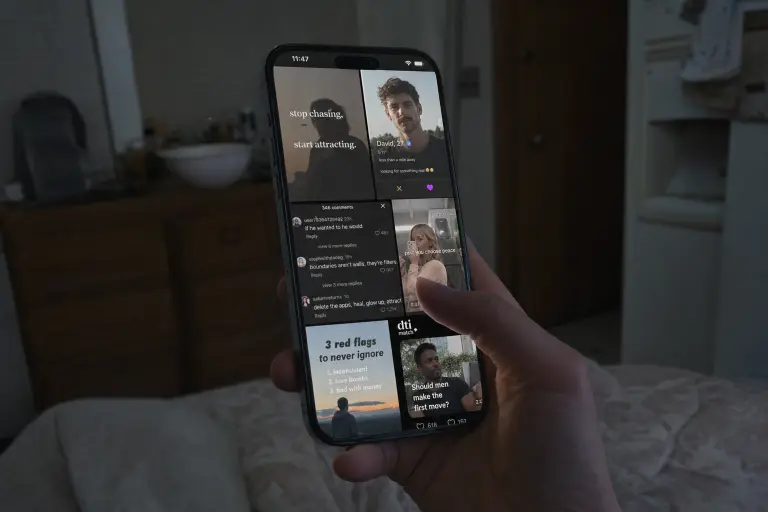
People are not only comparing partners. They are comparing realities.
The modern couple competes against a fictional composite: the sexual chemistry of one viral pair, the communication skills of a therapist's Instagram post, the income of a finance creator, the emotional availability of a romance novel, the domestic aesthetics of a home account, and the personal growth vocabulary of a podcast guest.
No actual person can survive that comparison for long.
This does not mean online relationship advice is useless. Some of it gives people language their families never had. Words like boundaries, emotional labor, attachment style, gaslighting, repair attempt, and nervous system regulation have helped many people identify patterns they once only felt as confusion.
Couples therapy becoming mainstream is one of the better cultural shifts of the last few decades. Many people now seek help before everything collapses, not only after an affair or crisis.
But the internet also turns private discomfort into public diagnosis. A partner is not forgetful; they are toxic. A conflict is not unresolved; it is a red flag. A boring month is not a season; it is proof you are no longer aligned.
The language of self-protection can become the language of disposability if no one teaches nuance.
What is the economic pressure nobody sees in romantic advice?
It is easy to say modern people give up too quickly. It is harder to look at the conditions under which modern relationships are expected to thrive.
Many couples are trying to love each other under the weight of housing costs, student loans, childcare expenses, unstable work, long commutes, medical bills, and the quiet panic of never quite catching up. Some are working multiple jobs. Some are raising children without extended family nearby. Some are answering work messages from the couch where they are supposed to reconnect.
Remote work gave some couples more time together, but not always better time. The home became an office, daycare, gym, storage unit, restaurant, classroom, and emotional pressure cooker. Delivery apps brought dinner to the door, but they did not bring rest. Digital wallets made spending easier, but not necessarily life more affordable. Buy now, pay later made desire feel manageable until the payments stacked up like invisible clutter.
Older generations often say marriage was harder in their day. In some ways, yes. In other ways, modern intimacy is asked to do more with less communal support.
The old challenge was often survival together.
The new challenge is staying emotionally connected while exhausted.
What exhaustion looks like at home
A person who has spent all day performing competence at work may have little softness left. A parent who has handled school forms, grocery prices, pediatric appointments, and Slack messages may not have energy for careful repair.
A couple may not be falling out of love so much as falling under the load of modern life. And because the culture offers so many exits, exhaustion can masquerade as incompatibility.
What happens when instant gratification meets slow love?
The modern world rewards speed with almost religious devotion. Food arrives hot in thirty minutes. A product arrives tomorrow. A song plays instantly. A map reroutes in seconds. An AI assistant drafts the message, summarizes the article, plans the trip, answers the question. Waiting has become a design flaw.
Relationships remain stubbornly slow.
Trust is slow. Forgiveness is slow. Desire changes slowly, then suddenly, then slowly again. Raising children is slow. Learning someone's fears is slow. Unlearning your own defenses is slow. Becoming safe for another person is the work of years.
Speed culture
The world teaches us to expect instant answers, instant delivery, instant relief.
Relationship time
Love still asks for repetition, memory, patience, and delayed gratification.
The mismatch
People trained by instant systems enter bonds that still require long, imperfect work.
This creates a mismatch. Strong relationships include boredom, repetition, misunderstanding, repair, and long stretches where nothing looks impressive from the outside. A good relationship is not always emotionally stimulating. Sometimes it is two people paying bills at the kitchen table. Sometimes it is sitting in traffic. Sometimes it is buying the same toothpaste for the tenth year. Sometimes it is not saying the cruel thing even though you know exactly where to aim.
Modern culture celebrates beginnings because beginnings photograph well. First dates. Proposals. Weddings. Baby announcements. Anniversary trips. Makeups after dramatic conflict.
Maintenance is less cinematic.
No one goes viral for calmly discussing resentment before it hardens. No one posts a highlight reel of choosing patience during a partner's depressive winter. No one gets applause for another ordinary Tuesday of not leaving.
But that is where long love is made.
Are relationships failing, or are people expecting more?
The doom story is tempting: people are selfish now, attention spans are ruined, dating apps destroyed commitment, everyone wants perfection.
There is some truth inside the complaint, but not enough.
Modern relationships may look fragile partly because they are asked to carry more meaning than ever. Many people no longer want a marriage that is merely functional. They want friendship, romance, emotional safety, sexual compatibility, shared values, shared parenting, financial partnership, personal growth, mental health awareness, and mutual respect for individuality.
That is a heavy job description for one bond.
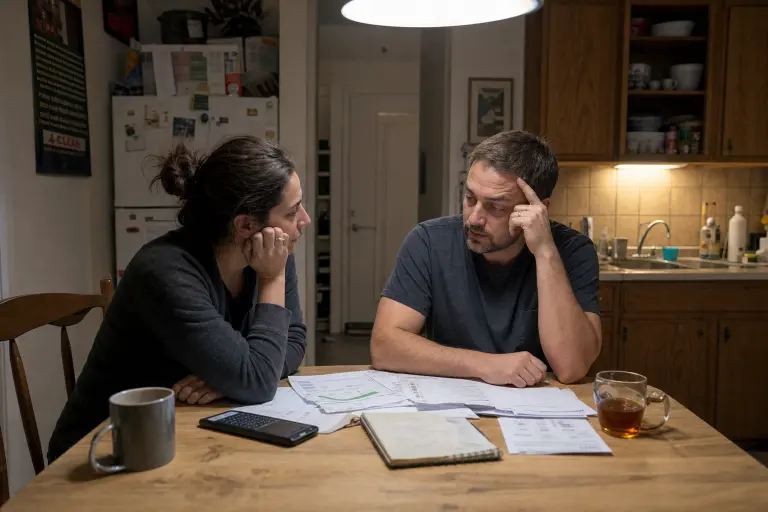
Historically, many marriages did not promise all of that. A spouse might provide children, social legitimacy, labor, income, or household order. Emotional intimacy could come from siblings, friends, religious community, or not at all. Some people accepted loneliness as part of adulthood because the culture did not tell them they deserved otherwise.
Now people want to be known.
That is not weakness. It is ambition.
Declining marriage rates in many developed countries do not only show a collapse of commitment. They also show people hesitating before entering institutions that no longer feel automatic. The rise of individualism has made personal fulfillment more important, sometimes excessively so, but it has also allowed people to reject arrangements built on obligation alone.
What looks like instability may partly be a society renegotiating what love is for.
The danger is that we may have raised expectations faster than we taught skills.
What does repair look like now?
Repair cannot mean returning to a past where people stayed because they had no money, no rights, no language, or no acceptable exit. That kind of permanence was often just captivity with better photographs.
Modern repair has to be chosen.
It looks less like suffering in silence and more like learning skills that previous generations often improvised badly: conflict management, emotional regulation, apology, expectation setting, financial honesty, sexual communication, division of labor, and the ability to hear disappointment without treating it as an attack.
It also requires understanding seasons. Some years are exciting. Some years are difficult. Some years are ordinary. Some years are shaped by babies, grief, illness, job loss, caregiving, debt, menopause, ambition, boredom, or reinvention. A relationship can feel different without being dead.
Ordinary does not always mean broken.
This may be one reason relationship therapy, coaching, podcasts, and educational creators have found such a large audience. People are searching for repair manuals because the old ones no longer fit. They do not want to be told to endure everything. They also do not want to throw away something meaningful because they never learned how to move through conflict.
Repair in practice
It is not a promise that nothing breaks. It is a habit of noticing what broke, naming it clearly, and deciding whether both people are willing to work on it.
The repair culture of the future will probably not look like the repair culture of the past. It will be more explicit, more data-aware, more emotionally literate, and more voluntary. The question is whether it can become deep enough to resist becoming just another self-optimization project.
What might commitment look like in 2075?
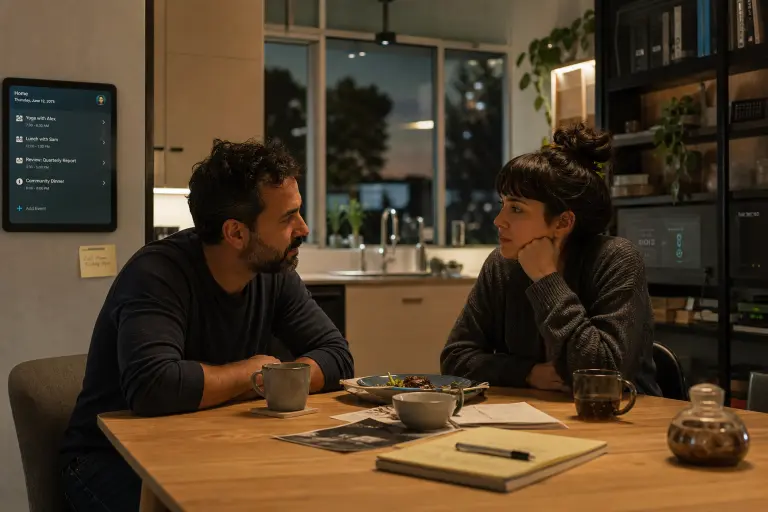
Imagine a couple in 2075 sitting at a kitchen table after dinner. The table recognizes their voices, but that is not the strange part. The strange part, to us, might be how normal relationship maintenance has become.
Their home system has noticed three weeks of clipped responses, reduced shared meals, and rising stress markers. It does not accuse. It asks whether they want to schedule a repair conversation. Their AI relationship advisor, trained on their communication patterns and chosen boundaries, reminds them that the same conflict appeared during a childcare transition eight years earlier and after a parent's illness twelve years before that.
Not as surveillance, ideally. As memory.
By then, many couples may use relationship maintenance platforms the way people now use fitness trackers. Not to guarantee love, but to notice patterns: quality time, conflict frequency, sleep disruption, emotional check-ins, domestic labor balance. Some partners may voluntarily share certain data to build trust after betrayal or distance. Others will reject it as invasive, preferring analog privacy in an age of emotional analytics.
Both reactions will make sense.
The real shift may be cultural. After decades of endless choice, some younger people may begin to see permanence as rare and therefore valuable. Not the old permanence of pressure and shame. A deliberate permanence. A commitment chosen precisely because leaving is possible.
In a world where everything can be customized, replaced, simulated, and optimized, staying may become a countercultural act.
Not staying no matter what.
Staying with attention.
Common questions about modern commitment
The rarest upgrade may be staying
Picture an elderly couple many decades from now, sitting together in a room that knows their preferences but not their whole story. The lights adjust softly. A kettle warms. Somewhere, a screen waits to entertain them, advise them, measure them, distract them.
They are not together because they never struggled. They are not proof that everyone should stay, or that love conquers all, or that the past had better answers. They may have hurt each other. Bored each other. Misunderstood each other. Changed in ways that frightened them both.
But across thousands of ordinary days, they kept returning to the work of knowing each other.
That may be the part modern culture forgets. The strongest connections are rarely built from constant happiness. They are built from choosing again after disappointment, boredom, stress, mistakes, silence, temptation, and change.
Freedom gave people the right to leave. That right matters.
Now comes the harder question: when leaving is always possible, what makes staying meaningful?
In a world obsessed with upgrades, the answer may not be finding a flawless person. It may be recovering the patience to repair what is still alive.