Air-Conditioned Saturdays: What We Lost, What We Keep, and What the Mall Becomes Next
The first thing you noticed was the smell. Cinnabon and chlorine and the sweet ink of fresh paperbacks at Barnes & Noble, all braided together under a humming grid of fluorescent light.
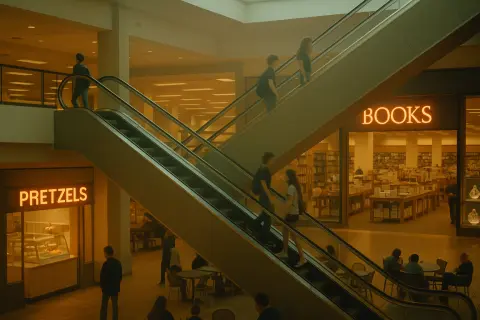
On Saturday afternoons in 1999, the mall was a movie you were inside of. Teenagers walked laps like it was cardio before cardio was a word. Parents dragged strollers past the giant fountain that flicked coins against the tile like rain. At Best Buy the black plastic towers of stereo speakers blocked the aisles like rock faces, CDs clicked inside their security boxes, and the blue shirts were priests of an early internet they carried around in beige boxes. RadioShack had a wall of tiny drawers full of resistors and LED diodes for people who didn’t just use gadgets; they soldered them into being. At Barnes & Noble you could sit and eat a cookie and flip through a glossy book about Iceland for an hour and pay for nothing but the cookie. The point wasn’t only buying. It was air-conditioning and adolescence, a way to be on display without meaning to be.
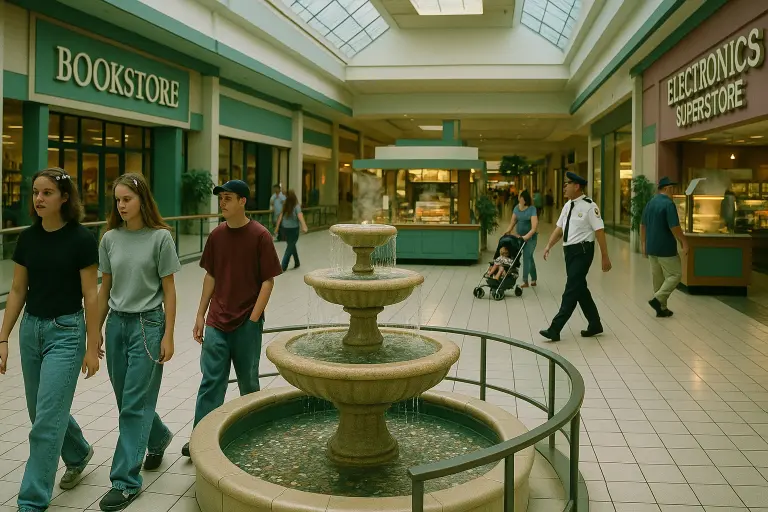
How did we leave the indoor town square?
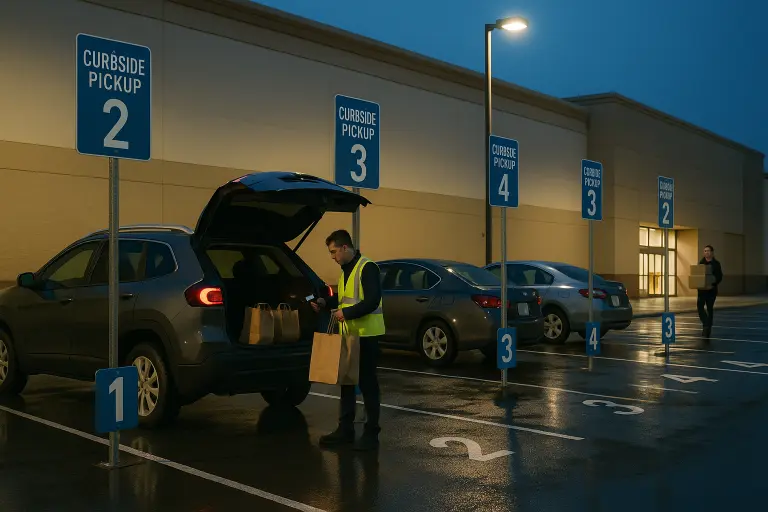
This is just twenty-five years ago. It might as well be a century. Somewhere around 2007 the screens in our pockets began to eat the aisles. By 2015 a remarkable phrase entered the language of ordinary errands: buy online, pick up in store. Then 2020 compressed ten years of retail change into ten weeks. Curbside pickup spilled into strip mall parking lots painted with temporary numbers that became permanent. Amazon stopped being remarkable and became a utility. In the quiet inventory rooms of a big-box store, a new profession bloomed. Not clerk, not cashier: picker. People who shopped as a job, wandering with handhelds, plucking paper towels and toddler socks and the same USB-C cable off predictable pegs, bagging them into waiting sedans.
If the mall was once our indoor town square, how did we get comfortable leaving town? The short answer is time. The long answer is a braid of culture, logistics, and trust.
Culture
We are creatures of comparison with less and less time to compare. While the mall offered touching and trying, the internet offered infinity. Every product developed a review chorus. A five-star convenience became the cultural baseline. A high school junior with soccer practice and homework and a hungry little brother could order cleats in the backseat of a minivan at a red light, and they would be at the door by Thursday.
Logistics
Logistics quietly remapped the landscape. Behind soft app buttons were hard miles: regional fulfillment centers built at the edges of towns; belts and bots; night shifts. Stores became nodes in a network. Best Buy started shipping web orders from stores because the store was effectively a climate-controlled warehouse decorated for humans. Target and Walmart mapped out back rooms with paths that only made sense to software.
Trust
Amazon stopped being remarkable and became a utility. TikTok turned shopping into a full-contact sport, an algorithmic bazaar where a ring light could move more mascara in an hour than any boutique did in a week. TikTok Shop and live shopping streams transported the hawker from a stall into a bedroom, re-stitching the carnival barker to the feed.
What did malls become in the 2020s?
And yet. Walk a former anchor store in 2024 and you will not find emptiness. You will find a DMV tucked into what used to be a home theater room, pickleball stripes freshly painted on a former Macy’s floor, an urgent care clinic lit like a softly staged kitchen, and in the atrium an electric vehicle charging lounge where there was once a carousel. The mall learned that fitness, healthcare, and bureaucracy pay rent better than a second smartphone kiosk. Big-box footprints turned into micro-fulfillment hubs to shave six hours off a route. There are algorithmic ad signs in the makeup aisle, retail media networks that rent your attention while you wait for a latte. Target and Kohl’s began hosting mini beauty stores inside their footprint because a trip that solves two problems is a better trip. Barnes & Noble, which looked like an elegy a few years back, has quietly hired store managers who curate like indie booksellers and started feeling local again. RadioShack is mostly a brand online now, in flux and periodic revival, but in maker spaces and repair cafes you can feel its old heartbeat.
The people who haunt malls today are different than in 1999. Instead of teenagers orbiting Hot Topic there are morning mall walkers with smartwatches, logging their steps before the stores open. There are kids practicing dance moves in front of dark windows for a social platform that pays them not in cash but in attention and, sometimes, discount codes. There are returners, a new retail species created by free returns: people shepherding Amazon packages to the counter at Kohl’s, letting one supply chain enclose another. There are photographers hunting for empty escalators and pastel carpets, feeding a nostalgia economy of dead mall videos that look like found footage from a dream you only half recall. The mall is not exactly dead; it has become a browser tab among many.
The mall is not exactly dead; it has become a browser tab among many.
Why did we drift away from the third place?
Why this drift? Even when online was worse, it was easier. We traded the feel of glossy paper and the thrill of a bag for the thrum of a doorbell because our lives were compressed. Work followed us into the grocery line. Our neighborhoods sprawled just a little more every year. Gas got expensive. Parenting moved into group chats. The atomization of activities dissolved the unplanned hour that made the mall a third place in the old sense Ray Oldenburg meant: not home, not work, a neutral ground. The phone swore it would give us time back. It took the shape of our time instead.
What do stores look like now, mid-transition?
Still, the store learned new tricks. Walk into Best Buy now and the loudest section is not speakers but the appliances corral, because dishwashers broke during the pandemic and people wanted them yesterday. The gaming PC aisle is glued with YouTube-open tabs. You will find a teenager tapping a keyboard in a way that reveals keyboard tryouts are now their own sport. You will find a locked glass case of GPUs and a staffer with a ring of keys like a jailer in a cyberpunk paperback, a reaction to a new form of shrink and theft that tugged the psychological thread retail depends on: touch what you could buy. On the way out you might step around a cart of brown bags sorted by car space number for curbside pickup. The store exists in two planes at once: showroom and distribution center.
The store exists in two planes at once: showroom and distribution center.
So what happens next?
How do you make a place that people go to when every object in it can come to you?
The answer in 40 years will not look like a re-skinned 1999, or last year with more screens. It will answer older needs with newer tools. We will still want a place to be, to bump into each other, to fix the things we rely on, and to see the options we did not know how to ask for. The mall in 2064 is not a mall. It is a neighborhood engine: part workshop, part clinic, part library, part market, wrapped in shade and running on a microgrid.
A Saturday in 2064: What does it feel like?
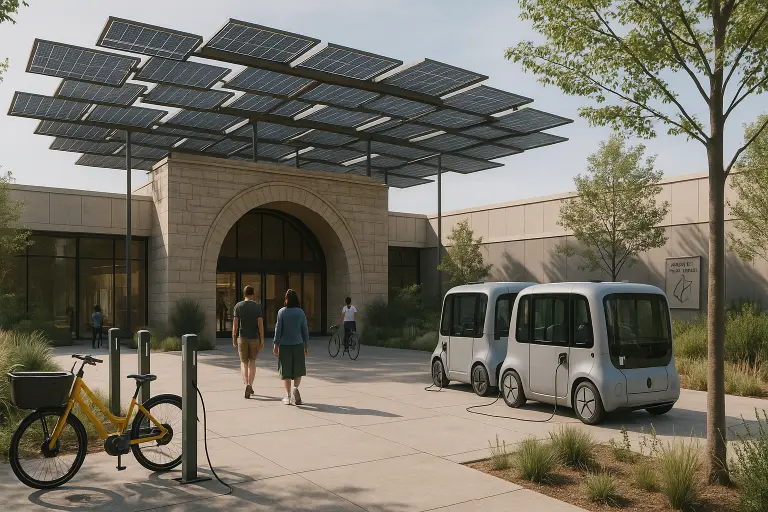
By noon the heat outside is serious but the skywalked interior is twenty degrees cooler. The old Sears entrance remains, but above it a canopy of solar glass arrays floats like flattened leaves. In the parking deck a line of silvered poles trickle charge into cargo ebikes and small autonomous shuttles. Trucks rarely come here anymore. Most big boxes for the region pass through a logistic spine at the edge of town, a clean low building that looks like a warehouse because it is, but with visible beehives of robot carriers inside instead of forklifts. What arrives at the district hub are the few things you need in your hands today or want to touch before deciding.
Repair, not replace
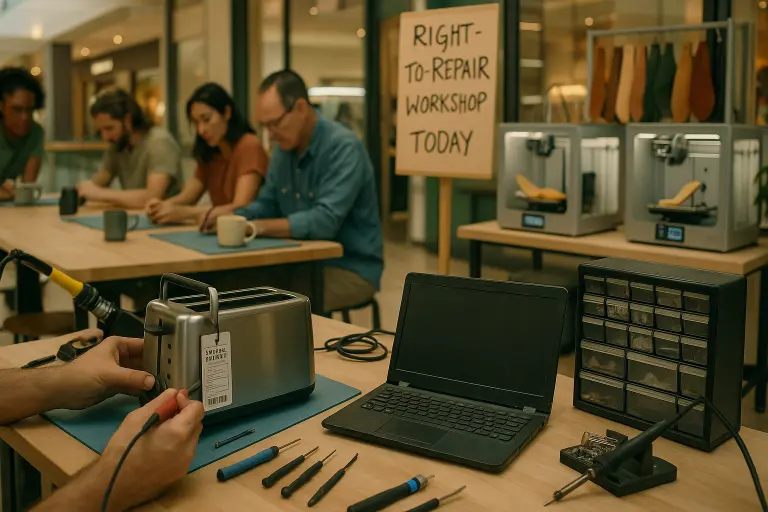
Inside the atrium you can feel that the urge to gather never left. On the left there is a workshop where strangers are learning to fix toasters and sort slow laptops, an iFixit kit open on the table. Right-to-repair didn’t just change the law in a couple states; it changed the temperature of our stuff. Products have passports now, standardized labels that report what is inside, how to open them, where to get the parts. If the early 2020s taught us anything it was that rebooting a device is not the same as renewing it, and that the pride of fixing something is more addictive than the unboxing of a replacement. The space hums with a smell of solder and coffee. This is the closest thing we have to RadioShack, but better; not a wall of little parts with terse clerks, but a stage for curiosity with people who stick around.
Local making, quietly
Near the food court, where there used to be five frozen yogurt options, there is a print farm. Next to a rack of plant-grown leather swatches are a set of enclosed printers quietly building soles or hinges. It is not the replicator fantasy, not everything on demand, but certain items do benefit from being made close by. A jogger with a foot that pronates has a scan on their phone; a tech matches an insole design; the shop prints it, dyes it, and glues it onto a stock shoe upper. You do not walk out in an hour with something no human touched; you walk out in two with something a human noticed. The file is in your own account, not floating in a brand cloud, so when you lose one on a muddy trail someone else can print you a match two neighborhoods away.
Bookstores as clubs, then schools, then squares
The bookstore has a new name but it rhymes with what came before. In the corner, a quiet press thrums, printing small runs as fast as coffee. On a long table are stacks of little local zines alongside glossy global titles, the manager’s notes in pencil in the margins of some covers. Barnes & Noble survived because it learned to be less like itself, delegating choice back to the store. The 2064 version makes that feel inevitable. If reading was the first algorithm, curation is still its best answer. Two students argue about a poet no one on social media has heard of yet. A mother and teenager in headset-glasses lean into a fragile shared moment over a cookbook that projects steps like a choreographed recipe onto their ingredient bins at home. Bookstores became clubs as much as stores, then schools, then town squares again. They never forgot how to smell like paper.
Showrooms, agents, and long memory
There are still what we might call stores. But they look like show kitchens in an architecture magazine. The inventory is thin, intentionally: a sampling of materials and colors and forms. In the back are micro-bays where robots pick up reserved items for the hour or assemble packages from the region. You are not expected to lurk and browse unless you want to. Most people arrive with an agent, a soft AI that is less a shopping cart and more a long memory. It knows the circumference of your dining table, the way your last umbrella bent in the wind. It has learned what you return too often and warns you against your own impatience. It does not talk over you. It whispers nudges on your lenses: this hinge is repairable; this version is easier to pass on to your cousin; your neighbor already owns the giant ladder, ask to borrow it. The recommendation engines that once treated people as wallets have become more like house managers because the economy learned: trust is stickier than coupons.
Clinics and cooling commons
Some spaces feel almost civic. There is a clinic where the anchor tenant used to be; it does not smell like antiseptic. It smells like cedar and lemon. People come here because aging happens, because teenagers break wrists, because heat waves turn lungs brittle. In the worst weeks of summer, the atrium is declared a cooling commons, and the power company will send a text nudging certain neighborhoods to use the mall as a respite while rooftop batteries discharge to shave peaks. Sears and JCPenney were once anchors. Now climate and care are the anchors. Malls survive by being the infrastructure other sectors need.
Selective friction
This future is not frictionless. It is selective with friction. When we wanted speed above all, we got it. Then we noticed what we had flattened: the pauses where decisions mature, the surprise of a staffer pulling a book from a lower shelf you didn’t know you wanted, the relief of a place to walk with no destination that still felt like one. The best stores in 2064 know when to insert that pause. They know the social geometry of a bench placed between two decisions, the relief of a face-to-face return counter instead of a cold chute that eats your mistake.
Calmer tech, clearer boundaries
The technology is there everywhere, but rarely looks like itself. Smart shelves learned to be predictive without glowing at you. After early stumbles with cameras in ceilings, retailers and neighborhoods set data boundaries: your shoes may talk to your own household pod, but not to the food kiosk you just passed. Apple’s early stabs at spatial computing gave way to a basic norm: your glasses want to be glasses first. Interfaces returned to hands: haptics in handles and textiles, product passports that tap with a real click.
Measuring what matters, together
At the edge of this new mall a space hums that would interest a 1999 RadioShack regular: a sensor library. It lends air monitors and soil probes and noise loggers to block associations, schools, and tenant unions. Data is the new wrench, the staffer says. It is a simple exchange. We will help you measure; you help us decide what matters. The mall becomes a place where objects and public will cross-pollinate.
Food that shows its face
A note about food. In the same forty years we learned to grow more inside. On a lid of the parking garage is an herb garden that supplies three restaurants downstairs; in winter microgreens light up like a mild aurora. Ghost kitchens once hid; now they hold office hours. You meet the person who cooked your katsu last week between their shifts and learn that she uses the district’s shared cold chain, not a fleet of motorcycles. Some food is delivered by tiny bots because it makes sense. Some by cousins because that always will.
Stewards of the habitat
What about Best Buy in 2064? It may not be called that, but the job will still exist: helping households manage their habitat of devices. Geek Squad turned into neighborhood tech stewards long ago; today they run a device clinic every Thursday where people bring in smart fridges that forgot how to defrost with dignity and doorbells that learned to be less nosy. The store’s revenue looks more like a library card crossed with insurance than like sales. Selling returns, but slowly. A brittle edge of the market was smoothed by standards: right-to-repair laws went national; companies learned to price longevity into their stories. Not every phone is modular, but every phone lasts longer.
Attention as the scarce thing
And Barnes & Noble? It will still be here, one way or another, precisely because attention will be the last scarce thing. Humans will gather around page-length thought the way they gather around campfires. The fact that vinyl came back was not a fluke; it was a hint.
We get to this version of the future not through any single breakthrough, but through a set of modest changes that compound. The speed of the last twenty years made us fluent in updates. The lesson of that fluency is not just that technology accelerates. It is that we can dial it. We can decide where to let the machine run and where to reclaim the wobbly human bits that keep us from turning into flattened diagrams of ourselves. Malls failed when they pretended not to be an ecology. They return when they admit that they are.
How do we live with the internet while still having places?
In 2024 a teenager and an uncle walk into a Best Buy. They are here to pick up a component ordered the night before for a gaming PC that will never be finished, not truly, because building is a way of saying yes to the future in little clicks. They stop at a table where a headset sits lonely, too expensive to buy on a whim, too heavy on the face to ignore. The teenager tries it and smiles in half-horror; all the space in the store warps into a landscape where a train moves through the ceiling. They take it off and blink. They head to the pickup counter where thirteen brown bags wait for thirteen cars. The staffer is kind. He is clearly good at being kind. On the way out they drift into the book section and the teen picks up a paperback that a million readers discovered on a phone, which is why it is printed here on paper today.
The exit door whuffs open. Wind from the parking lot smells like asphalt and fried dumplings. The mall is still doing its old job: giving a shape to a Saturday. Outside, someone jogs past an empty store with a sign that says coming soon: courts. In thirty years, courts for games gave way to courts for people. In forty, both will be in the same complex, with a coffee counter that knows not to upsell anyone who looks like they just lost.
Not every place will make it. Some malls will become schools. Some will become data centers whose whir is the mechanical version of applause. Some will go on being haunted by teenagers doing choreography in front of a shuttered Aeropostale, posting it to a crowd elsewhere. But a surprising number will find second lives as the layers of our lives pile back together in public again.
The phone swore it would give us time back. It took the shape of our time instead.
What did the mall give us that the feed never could?
Serendipity you can walk toward. A way to mishear a stranger in a way that becomes a story. A bench. The sound of coins flicking the inside of a fountain. The awkward hello to a classmate outside study hall life. Light on glass even when the sky outside bruised black with storm. The knowledge that, somewhere easy to get to, things were waiting to help you become more yourself.
The future of the mall is not a resurrection. It is an admission: that we like to gather around objects and each other, and that even in an age of deliveries and drones and agents that know us better than our best friend, we will still need a public interior. We built malls to sell. We will keep them to live.
Common Questions About The Future Of Malls And Brick-and-Mortar
No. Online will keep expanding for commodity goods, subscriptions, and routine restocks, but physical spaces will remain for discovery, community services, health care, repairs, and try-before-you-buy experiences. Stores will function more like hybrid showrooms, service hubs, and local logistics nodes than pure warehouses of inventory.
Several. Barnes & Noble’s recent resurgence via local curation, direct-to-consumer brands opening permanent stores after years online, and malls filling anchors with clinics, gyms, and government services suggest the pivot to experience and utility is underway. The growth of buy online, pick up in store and convenient return counters also keeps people visiting.
Expect calmer tech. Spatial computing overlays that help without shouting, product passports for repair and resale, smarter shelves and carts that do not feel invasive, and AI agents that manage household needs while respecting local data boundaries. Automation will hum mostly in the back, while front-of-house emphasizes human help and tactile choice.
They evolve into service-centric platforms. Sales matter less than memberships for support, device clinics, installation, and lifecycle management. Their spaces will double as micro-fulfillment hubs and community tech centers, with staff trained as stewards rather than pushers of inventory.
Yes, though the anchors will change. Expect indoor streets that mix food, workshops, clinics, small-run manufacturing, and curated retail. Cooling commons during heat waves and energy microgrids will make many malls civic infrastructure as much as shopping venues. The culture of gathering will persist; the layout will catch up.