The Saturday Market Comes Back
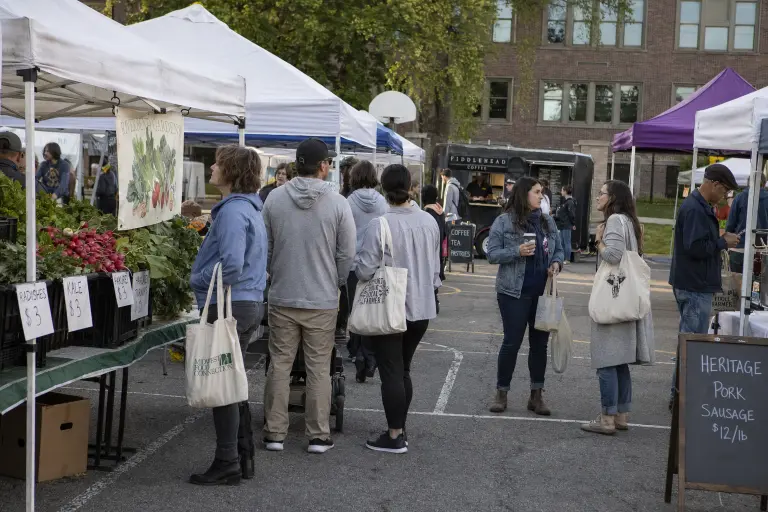
On Saturday mornings, the line for tomatoes begins before the coffee cart opens. It is a small scene, almost stubbornly ordinary, and that is exactly why it matters.
It is not an impressive line by the standards of modern commerce. No one is refreshing a screen, watching a progress bar, or waiting for a delivery window to narrow from 8 hours to 2. There are no countdown timers. No sponsored placements. Just a dozen people standing under a row of pop-up tents in a school parking lot, holding canvas bags and talking with the awkward tenderness of neighbors who are relearning how to be neighbors.
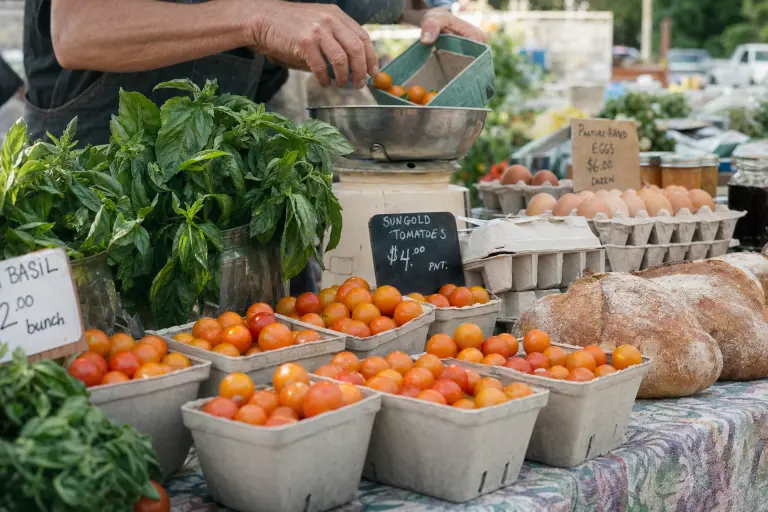
The tomatoes are expensive. Everyone knows this. A woman in a faded fleece says it out loud while reaching for a paper carton of Sungolds. She could buy a plastic box of tomatoes for less at the supermarket, and the supermarket has air conditioning, self-checkout, and parking spaces wide enough for distracted parents. Here she has to carry cash because the card reader sometimes fails. She has to ask what is still available. She has to accept that strawberries are gone by 9:30.
Still, she buys the tomatoes.
What changed in the way people shop?
This is one of the quieter changes in the way people are living now. After years in which convenience seemed to win every argument, local shopping has begun to matter again. Not everywhere, not for everyone, and not in the sentimental way people sometimes describe it. Most households still rely on large platforms, national chains, and the calm magic of getting toilet paper delivered before anyone notices they are out. But a different instinct has returned alongside all that speed.
People want to know where some of their money goes. They want to feel less extracted from. They want an errand to mean something other than inventory moving through a system.
Why did local shopping start to feel different after the pandemic?
The renewed interest in farmers markets, neighborhood shops, repair counters, local grocers, and independent makers is not just nostalgia. It is a response to what the last several years revealed. The pandemic made supply chains visible by breaking them. It made the fragility of small businesses visible by closing their doors. It made loneliness visible by turning ordinary transactions into risks, favors, and acts of trust.
When the world reopened, many people did not simply return to shopping. They returned to the question of who was still there.
What did the pandemic reveal about everyday buying?
Before 2020, local shopping was often treated like a lifestyle preference. It belonged to weekend markets, curated main streets, holiday gift guides, and people with enough time to care where their carrots came from. The dominant promise of retail was frictionless life: faster delivery, infinite choice, lower prices, fewer conversations. A person could furnish a home, stock a pantry, buy clothes, order medicine, replace a charger, and send a birthday gift without speaking to anyone outside their household.
Then the pandemic disrupted that promise. In the early months, convenience did not vanish, but it became uneven. Some items disappeared. Delivery slots filled. Restaurants turned into improvised grocery stores. Bookshops became phone-order dispatch centers. Local cafes taped handwritten menus to windows and asked customers to text when they arrived.
A takeout order was no longer just dinner. It was a vote for the Thai place that had hosted birthday meals and first dates. A gift card was not merely a future purchase. It was an advance of trust.
People who had once seen nearby businesses as interchangeable began watching them like weather systems: open, closed, reduced hours, curbside pickup, please be patient, thank you for keeping us alive.
What current cultural signals make the shift easier to see?
Farmers markets as social spaces
They are no longer just food stops. They are places where young parents, retirees, chefs, teenagers, and office workers cross paths without a formal invitation.
Resale and repair
Circular shopping has trained consumers to think about the life of an object beyond the purchase moment.
Short video and local discovery
A baker's morning tray, a florist's back room, a grocer unpacking peaches, a ceramicist glazing mugs at midnight can now feel vivid before anyone walks in.
What do people really buy when they choose the farmers market?
The farmers market is often described through freshness, seasonality, and quality, and all of that matters. A peach that was on a tree two days ago tastes different from one designed for travel. Eggs with deep orange yolks make breakfast feel more deliberate. Greens bought from the person who grew them tend to avoid the bottom drawer rot that afflicts supermarket produce purchased in a burst of aspiration.
But people are buying more than food. They are buying orientation.
Modern shopping can leave a person strangely dislocated. Products appear from nowhere and disappear into cabinets. Algorithms remember preferences, but not lives. A farmers market, by contrast, insists on context. There is weather. There is season. There are shortages and abundance. There are farms with names, fields with floods, orchards hit by late frost, bees that did well or did not. You cannot pretend food is frictionless when the person selling lettuce says the heat made everything bolt early.
Malik in Denver
A father starts going to the Sunday market because his son likes talking to the mushroom grower. The mushrooms cost more than grocery-store ones, but curiosity is hard to schedule into a weekday.
Joanne in Maine
A retired nurse buys bread from the local bakery even though a supermarket loaf costs half as much. The expensive loaf helps her avoid the small sadness of eating without ceremony.
Two roommates in Chicago
They order bulk rice and cleaning supplies online, but keep buying coffee beans from a neighborhood roaster because it gives their block a reason to know them.
Why are small businesses becoming cultural anchors again?
A small business can sell soap, records, noodles, bicycle repairs, children's shoes, or houseplants. But when it lasts long enough, it also sells memory. People mark their lives against it. They remember the cafe where they waited for job news, the corner store that gave them credit during a hard week, the tailor who fixed a jacket before a funeral, the bookstore where their child learned to choose slowly.
This is why the loss of small businesses can feel disproportionate to their square footage. When a chain closes, it may inconvenience people. When a local shop closes, it can remove a piece of the neighborhood's self-knowledge. There is no app notification for that kind of vacancy.
The quiet labor of local knowledge
Small businesses have also become cultural translators. A local grocer knows when a new immigrant community needs particular spices, grains, or phone cards. A barbershop understands local politics before polling does. A plant shop sees who is nesting, who is grieving, who is trying to make a rental feel permanent. A running store notices when more women are training before sunrise because flexible work has rearranged their mornings.
These shops collect behavioral data the old way: through repetition, listening, and the casual intimacy of commerce.
Can local commerce survive alongside giant platforms?
For years, the story was told as a contest with one inevitable winner. Large platforms had scale, data, logistics, and price. Small businesses had charm, and charm seemed fragile against a delivery network that could place almost anything on a doorstep by morning.
The next chapter is likely to be more complicated. Local commerce will not replace large platforms, but it may regain importance by becoming better at what platforms struggle to provide: embodied trust, local knowledge, immediate service, sensory experience, and civic presence.
Some of this is already happening through technology.
Farmers market vendors take mobile payments, send inventory updates by text, and use simple subscription tools for weekly produce boxes. Independent bookstores share online catalogs while still offering staff recommendations. Local shops use short videos to show what arrived that morning. The future of local retail will not be anti-tech. It will be selectively tech.
What could local shopping look like 40 years from now?
Imagine a Saturday in 2068. The market still begins early, though the tents are lighter now, made from adaptive fabric that cools in heat and tightens before rain. Some farms are outside the city, some are vertical cooperatives built into old office parks, and some are soil-based operations protected by regional food trusts after decades of climate volatility made farmland too valuable to leave entirely to speculation.
A teenager walks through the market wearing small translation lenses. Vendors display origin data, water use, harvest dates, allergen trails, and cooperative ownership details in quiet overlays that appear when someone chooses to see them. Most shoppers ignore half of it. They still ask the farmer, What is good today?
Local commerce in this future is not quaint. It is part of resilience planning.
The local layer has thickened
Neighborhoods have a commerce commons: part market hall, part repair library, part food distribution point, part social space. Residents subscribe not to a single store but to a local basket of services. Digital wallets show where money circulates, not as a moral scold but as information.
Objects are modular. Shoes return to maker networks. Appliances are repaired locally. Clothing is altered and re-cut. The goal is no longer simply to buy nearby. It is to keep things in use within a place.
Why do people pay more for local goods?
The simplest answer is quality, but the fuller answer is that price is only one kind of cost. Convenience hides labor. Cheapness can hide distance. A local product may cost more because wages are higher, rent is real, ingredients are better, production is smaller, or the seller is not subsidized by scale.
People also pay for accountability. If a loaf is stale, you can tell the baker. If a chair wobbles, you can return to the maker. If a farm has a bad season, you see the consequences rather than experiencing them as an empty shelf with no explanation.
The real appeal is not purity
Small businesses can fail workers, overcharge, exclude, or disappoint like any institution. But proximity makes certain kinds of accountability more available. There is also pleasure: the pleasure of being recognized, of choosing among fewer, better things, of walking home with flowers you did not plan to buy, of hearing someone say, I saved one for you.
The errand as a form of citizenship
One of the overlooked truths of daily life is that errands shape how a place feels. A neighborhood where every need requires a car trip to a distant warehouse store feels different from one where a person can buy onions, mend a zipper, pick up medicine, and run into someone they know. Commerce is not separate from civic life. It is one of the ways civic life becomes visible.
This does not mean every purchase must carry moral weight. No one can live that way for long. People will still chase discounts, forget birthdays, order the wrong size, and choose speed when the week collapses. The point is not purity. The point is attention.
Local shopping asks for a little more attention. It asks people to notice that the fishmonger closes early because his crew starts before dawn, that the florist stocks fewer roses in August because heat has changed the supply, that the toy store is hosting a board game night because teenagers need somewhere to go, that the cafe owner looks exhausted because card fees rose again.
These details can be inconvenient. They can also make a place feel real.
Back at the market
The tomato line moves slowly. Someone asks about canning. Someone else complains about the price and buys two cartons anyway. A child drops a pastry, cries briefly, and is handed the less damaged half. The farmer weighs tomatoes on a small scale and rounds down without mentioning it.
By noon, the best produce is gone. The tents come down. The parking lot returns to being ordinary asphalt.
What is the future local commerce is reaching toward?
Later that afternoon, some of those same shoppers will open apps and order things from far away because life is complicated and nobody survives on principles alone. But dinner will taste like the morning. The tomatoes will be sliced with salt. The bread will tear unevenly. Someone will mention the farmer, the baker, the line, the child with the pastry, the fact that peaches might be better next week.
Money will have moved through the neighborhood and left behind something more than a receipt.
That is the future local commerce is reaching toward: not a world without platforms, but a world where platforms are not the only places people turn when they need something. A world where the local shop is not a decorative relic, but part of the operating system of everyday life. A world where buying nearby is sometimes inconvenient, sometimes expensive, and sometimes exactly what makes a place feel like home.