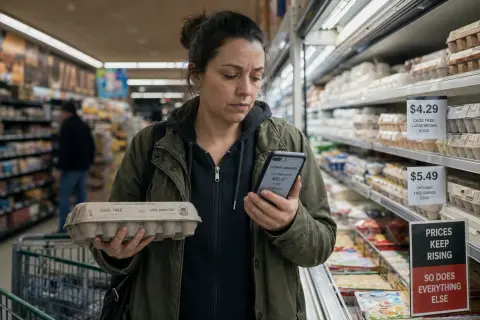
The Month of Unnamed Charges
On a damp Tuesday in late autumn, the phone chimes while Maya is rinsing rice. Not the text ping or the message bubble buzz, but the soft knock of the banking app that used to feel like a smoke alarm and has, lately, become background noise: You spent $4.99 at CloudCache+. She dries her hands on her shirt and blinks at the screen. CloudCache+? It jogs nothing. Maybe it was that audio transcription upgrade she tried for a week, the one with a rabbit icon, or the backup of a backup of the family photos that her husband swears they might someday need. She flicks through a carousel of receipts: a pet food loyalty plan; an enhanced weather alert; a traffic app that promised accident detours on snow days; a password manager she is pretty sure she canceled. Maya scrolls until the sink fills too high and the rice sloshes into the drain.
It was supposed to be convenience. The subscription as polite assistant. The toothbrush heads arriving on exactly the day they were needed. The stash of coffee that never ran out. More than that: the idea that the frictionless, pay-by-the-month universe would outsource the part of living that feels the least like living. Little decision after little decision, none of them wrong, until one day people woke to discover they had a pantry filled with standing orders and a calendar scattered with silent withdrawals from merchants whose names sounded like apps waiting to be deleted.
What changed was not a villain. It is almost always never a villain. It was the soft pressure of the past decade of software and services coaxing us gently away from ownership and into access, away from waits and into drops, away from households that tracked the cost of jars and tune-ups and toward screens that tell you it is only $2.99 a month. The home became a patchwork of recurring privileges: the doorbell that needed a plan to save clips so you could catch the raccoon at midnight; the printer that would not print unless the ink service recognized your model; the exercise bike that got bored without its monthly classes; the thermostat that asked for a subscription to suggest Tuesday heat schedules.
No one set out to live a life negotiated in monthly micro-installments. Yet here we are.

How convenience learned to erase itself
Why did forgetting become profitable?
The first years of the subscription wave felt like discovery. Newsrooms said they were finally reader-supported. Music and TV at buffet prices. Even groceries had Subscribe & Save banners like a friendly local who knows your usual. We celebrated the end of dreaded one-off purchases that turned everything into a mini-project: compare prices for a router, drive to a store, read a sheet of paper, keep the receipt. Set it and forget it became the new grown-up superpower.
Then came the quiet scaffolding that made forgetting profitable. Emails filtered into Receipts folders that we never opened. Cards on file turned into tokens that updated themselves when plastic expired, a bit of payments wizardry meant to smooth good purchases that also kept bad ones living like old houseplants no one watered but somehow never died. There is a phrase for it in the industry: account updater. A carrier or a card network passes along your new credentials to merchants to prevent interruptions. You stop your card to stop a subscription, but the subscription does not stop; it finds your new card automatically.
If you wanted to flag every charge, you could turn on alerts. But that made the flood worse. Your wrist trembled with haptic buzzes for a $1 test authorization, then a $2.99 weather alert you do not remember authorizing but agreed to in a chalice of terms somewhere between an app install and a map download. You told yourself not to be dramatic. It is the price of not thinking. You were right. And also you were wrong.
The stack of life
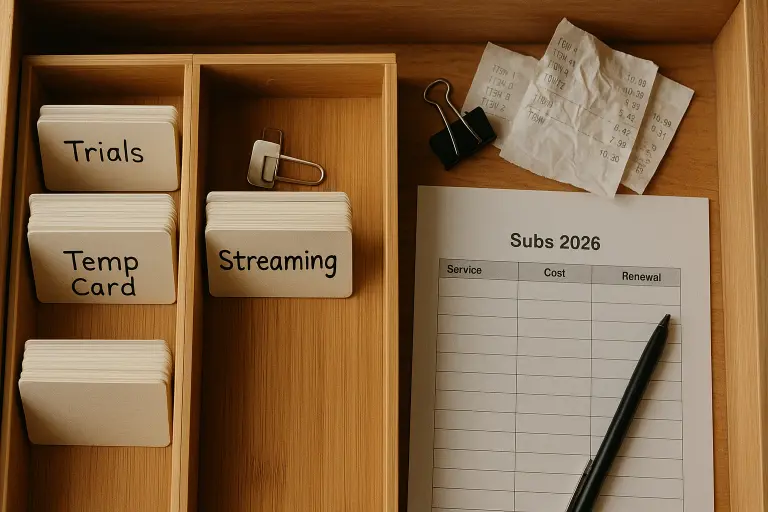
Open any kitchen drawer that used to hold coupons and you will find, in many homes now, something else: a pinched stack of virtual cards, one for trials, one for stores you do not trust, expiration dates set to the month. A spreadsheet tab named Subs 2026 in the family budget folder. A family group chat with four logins to four platforms, cousins chiming in with who watched what last. We shuttle our entitlements around like chess pieces, rotating platforms in and out, canceling in June and coming back in October for a new season, keeping a running tally of which services are unforgiving about reactivation fees.
The behavior is the story. The average person, if averages matter anymore, now juggles streaming, music, cloud storage, fitness, news, password management, design software, meal kits, a meditation app, a couple of newsletters behind paywalls, a digital notepad with a pro tier, a dog-food plan with glossy postcards, an online video editor for that one time you had to caption a clip. Families have become cooperatives of convenience, not far from what our grandparents did with car pools and church basement swaps, but with email receipts and push tokens instead of cookie tins and phone trees.
The culture plays mediator and hall monitor. There was the summer a few years back when carmakers flirted with subscriptions for heated seats, and the internet made its voice hoarse saying no. That burst of resistance was not about warmth on cold mornings; it was the moment people understood how far the logic of endless add-ons would try to reach if given permission. It put a boundary around the body and the car, around the appliance and the entitlement. This far and no farther.
Signaling the turn
Then, in living rooms and dorms, came the password crackdown of a streaming giant that had marketed sharing as a love language and then closed the door. Families performed a modern ritual: a ritual not of cutting cords but braiding them, choosing who gets which password, which 4K tier, which months to pay and which to pause, like rotating the crops. It was not an uprising, exactly. But it was a reeducation. We learned again where our money goes, if only for a season.
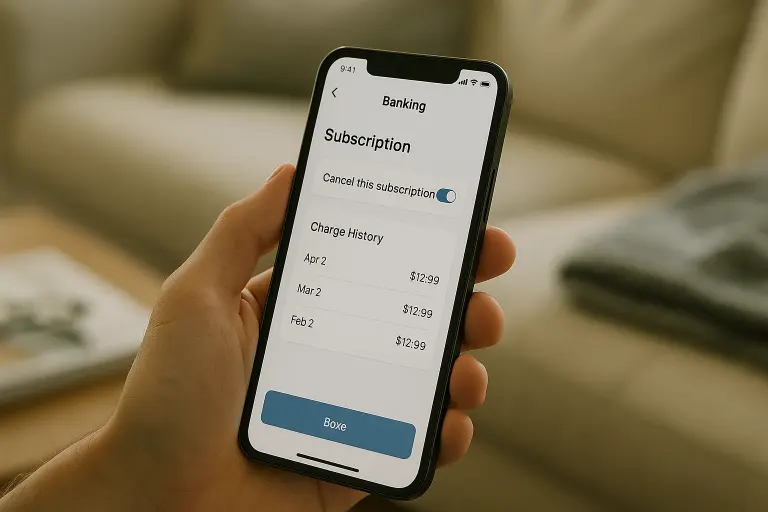
You can track the shift in a few public signals. Subscription management apps rose from niche curiosities to household tools. Rocket Money, Trim, Hiatus and their cousins turned the art of calling customer support into a one-button ritual. Banking apps added Cancel This Subscription toggles under Payments, where customer loyalty teams once hid the escape hatch. Legislators smelled a story and a constituency: proposed click-to-cancel rules, dark pattern crackdowns, a general sense that the golden age of trick-cancel pages and maze-like account portals might be closing, at least by law if not by design.
Households experimented with no-subscription months the way some go on sugar fasts. In professional circles, annual budgets began to list not software licenses but software offboarding plans. School PTAs drafted How to Manage Subscriptions night classes. It became possible to admit out loud that you were overwhelmed not only by the cost, but by the thought of keeping up with what you pay for.
Why it became too much
You feel it first in your head, not your bank balance. Cognitive load is the tax you pay for choices multiplied. Once, a toolbox had a hammer, a screwdriver, and a wrench you borrowed from your neighbor. Now the toolbox is a folder of icons, each with a meter. You learn the peculiar math of value across invisible lines. Is $3 a month for text extraction worth it if you use it three times a year? The number is small enough to be ignorable, until you add the other small ones and feel like you are paying rent to a dozen invisible landlords.
The technology rewarded forgetfulness. That is a harsh way of saying the system was designed for good reasons: to reduce friction, to keep the lights on, to promise that nothing will break just because a physical card expired. But a system that reduces friction is also a system that encourages glide. Autopay is mercy until it is not. The same is true for loyalty programs that hide rewards behind memberships, for in-app teams who measure churn more than sentiment. The software is not unkind. It is just indifferent to your limited attention.
When tipping prompts started appearing in places where there were not tip jars before, people did not always revolt; they recalibrated. With subscriptions, recalibration has been slower because each micro-fee has plausible deniability. Every $1.99 is a good story. It is the story of an app you love, a feature that makes mornings work, a donation to future-you who will thank past-you for not having to remember to reorder cat litter. Cultural stories thrive on these half-truths because they are entirely true on their own, and only not-true in aggregate.
It was the feeling more than the math. A steady hum of attention-drain that made even good services feel like chores. The ledger, still years away in this part of the story, solves for attention as much as for money.
Observation from a kitchen table spreadsheet.
The day of paper again
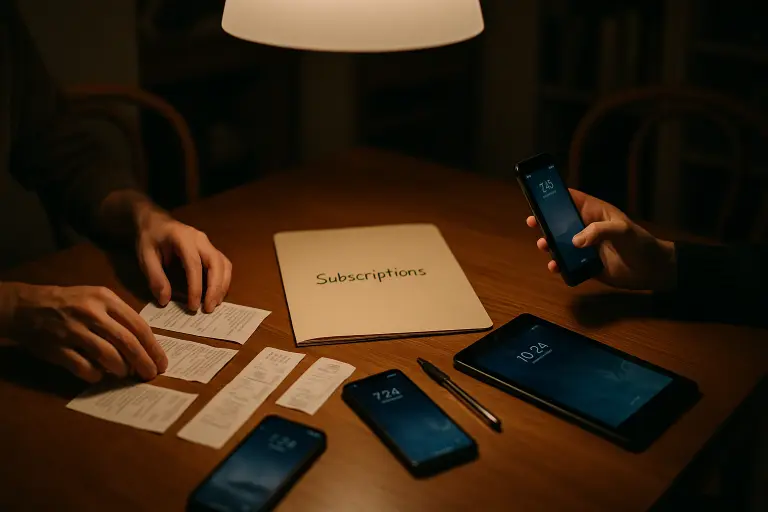
The pushback is low-fi precisely because the problem is high-fi. A friend who works in a newsroom told me her desk drawer has a manila folder labeled Subscriptions where she slips printed receipts every January, just to see them exist in a pile she can touch. It is so quaint it is almost parody, and also the only thing that worked for her brain. Another friend, a software engineer, uses a homegrown robot that marks every new recurring charge in a shared calendar. On the first of the month, the calendar looks like a confetti cannon. He laughs when he scrolls through it with me. At the end of the month, he goes line by line, deleting the ones that annoyed him. He calls it pruning.
A neighbor made a ritual. The last Friday of the month, after dinner, all devices on the dining table. The family plays a game: guess the merchant. Someone calls out $2.99 Century Clouds. Winner gets to delete an app from someone elses home screen. They are not moral crusaders; they are exhausted. Convenience turned into a hobby they never asked to practice.
Businesses, nudged by regulators and shamed by watchdogs, have started to build the opt-out muscle. One-click cancel buttons appear where labyrinths used to be. The billing team, once an afterthought, now features in the product roadmap. The golden metric is not time-on-site but trust. It turns out that a consumer who believes they can leave is more likely to stay.
Pauses and pilots
You see small experiments in un-bundling. A publication offers day passes because it found out that people were using incognito windows like travelers sneaking into a museum. A music platform pilots neighborhood and family caps that sit below individual fees because they did the math: one household with three fans is more valuable than three households anxiously cycling in and out. The more ambitious experiments look like utilities: a city library system quietly negotiates museum and transit access and folds them into a single civic card. The bill arrives as part of taxes, not as a monthly nudge. People barely notice; they notice when it stops.
And underneath all this, the hidden mechanics of payments are changing again. Open banking rails make it easier to pull money from accounts directly, bypassing cards that can be locked. Digital wallets turn entitlements into items passed between phones like temporary badges. Merchants must publish machine-readable cancel endpoints. The infrastructure is catching up to the human desire to not keep a masters degree in remembering what we bought.
It is not an apocalypse. It is a retuning.
A near future we can recognize
Fast forward, not to utopia, but to an apartment in a city 40-odd years from now. There is still a sink and rice and a Tuesday. There are still subscriptions. But there is also a presence in the home that is not quite a voice assistant and not quite a bank. People call it the ledger, out loud and without irony, as in Hey Ledger, did the kids use any of the math tutor credits this month? The ledger is an AI, but that word has worn thin from overuse. Better to call it the household CFO that does not sleep.
The ledger knows who lives here because it lives here. It senses that the living room TV has been dark all month except for weekend afternoons when the kids watch a channel that is easy to license by the hour. The ledger knows that the gym near the subway added an infrared sauna that no one in this home has booked once. It knows that Maya v2.0s equivalent of Rocket Money, now a thin layer inside her bank app, renegotiated the dryer maintenance plan in February after the manufacturer introduced a usage-based option that saves this family $14 a month if they agree to forgo Saturday service windows.
Automation, finally, got into the negotiation business. Not just canceling or paying, but asking: What can you actually do for me? There is a protocol for this now, not a fad but a standard, with a name you would expect to find printed on the inside of a manual no one reads. Merchants publish machine-negotiable terms. Household ledgers publish preferences. Agents meet in the quiet hours and swap proofs. The households prove they are real, that they paid last month, that their teenagers qualify for student rates. The merchants prove their service is in good standing, their uptime is what they say it is, their price is not a guess. It happens while we sleep.
Some people choose an aggressive mode: Never pay for unlimited anything. Buy only what we use. The ledger assembles a week of streaming as a patchwork quilt of per-episode licenses and ad-supported freebies, a practice that would once have been masochism and is now invisible. You do not pay $15 for the month; you pay 60 cents for an hour. Your home agent trades spare compute cycles to a neighborhood network in exchange for credit on your news paywall. All this is less futuristic than it sounds because the seams have been sewn shut. You do not see the barter; you see the bill go down.
Others set a principle: Own what is closer to the body. A bike is a bike, no tethers. The argument that boiled over when a carmaker tried to rent drivers the right to feel their seat warm was never entirely put to bed, but it matured. The new guideline: physical function is not a monthly thing. Upgrade paths exist, but they are tied to parts, not dials on a dashboard that someone far away can lock. People remember what happened last time. They carry that memory into the store with them, even when the store is a translucent overlay inside a lens.
And a third set of people decide to opt out entirely from micro-fees on basics. Cities, sensing that civic entitlements make cultural sense, bundle transit, museums, and public media into the tax code and tell households: You already pay. That model spreads to broadband in dense areas, to city-run cold storage for data backups, to public domain AI tutors. A thing we forgot how to do, pooling money for things we share, flickers back in a new suit, not out of nostalgia but because the math works.
The new invisibility: managed, not ignored
The ledger is not magic. It inherits our preferences and our mistakes. Some households set it and forget it and end up back where they began, trusting something else to do thinking they do not want to do. But the default state is different. Consent is declared in advance in ordinary language: No monthly bills for health or heat unless tied to usage and capped. All entertainment rotated quarterly. School-related tools always on. Negotiations must respect these boundaries.
Merchants adapt because they have no choice. They get to court the ledger. A gym convinces the home agent that this family swims often enough to warrant a new family cap. That argument takes place between machines reading rights and caps and, if all goes well, ends with a note in the kitchen: You saved $12 this month by not paying for what you never use. This is not utopia. It is just ordinary intelligence applied to a boring problem.
There are pockets of rebellion against the machine; there always are. Some artists sell albums as heirlooms again, one-time purchases that come with physical proofs and liner notes that glow when you hold them up to a UV light. Some magazines mail printed inserts that serve as keys to archives, not because they have to, but because their readers want to touch what they bought. The ledger does not stop you from doing this. It records it. It reminds you that you paid once and own it forever, so when a company tries to solicit you again, it declines with the small, satisfying brutality of a closed door.
It all started with a feeling, not a fight
If you talk to people about the turn, they do not cite a particular day, though a few remember the week a streaming platform added ads and then charged to remove them. Others recall the family lecture about sharing passwords that felt like a breakup text from someone you thought understood you. It was not these moments individually, though they served as rituals. It was a slowly dawning unease at the idea that every part of their day had a meter running somewhere they could not see.
The backlash was not a boycott. It was a return of attention to places that had drifted into the fog of automation. Not fury, but housekeeping. In the future, people will tell stories about the Subscription Cleanse of the 20s and 30s the way we talk about capsule wardrobes and decluttering today. Not because they were purists. Because they were tired.
Will subscriptions disappear? Some will. The fluff and the predatory ones will die. News and music will settle into a mix of civic support and direct patronage and flexible passes. The shadier tactics will be impossible because households do not talk to sales pages, they talk to standards. The rest will be managed by machines we train, the way a garden is maintained by a timer on the sprinkler. You still have to check the soil.
Back at the sink, some Tuesdays from now, Maya taps a tiny bell icon next to CloudCache+. The ledger pulls up the contract: free tier sufficient for this homes backups, paid tier only required when storing video for more than 30 days, which they have not done in twelve. Would you like to downgrade? asks the quiet window in a font she likes. She flicks Yes, as if swatting a fruit fly. She does not feel triumphant. She feels relief, then the small rush of a person who remembered to lock the door. The rice is fine. Dinner goes on.
What is changing now?
Usage over promises
Value is increasingly measured in usage, not in promises. When our tools can meter fairly and privately, we are more willing to pay by the hour, day, or page.
Consent, made explicit
Consent is turning explicit even for money. Households choose budgets and principles, not individual line items, and let their agents do the arguing.
Civic bundles return
Civic bundles are returning. Cities and communities are bundling entitlements so we do not negotiate for basics one app at a time.
Less gray area
The gray areas are shrinking. Dark patterns are falling out of fashion and, in places, legality. We are choosing clarity because the cognitive cost of confusion is simply too high.
Common Questions About Subscription Overload
It is not the number; it is the feeling. If you cannot list the top ten you value without checking your email, it is too many. Cognitive load, not count, is the test.
They help find and cancel, and some will negotiate better rates. They are most effective as a nudge and a log. The bigger shift comes when your bank or home agent manages terms by default.
For many households, yes. Watching in seasons, then pausing, can cut costs without cutting joy. It also restores attention; you watch what you pay for because you planned it.
It already does in small ways. As standards mature, agent-to-agent negotiation becomes normal. You set preferences and caps; your agent handles details.
The ones that charge for access to a function you already own or to a library you barely use. Physical features behind paywalls face cultural resistance. Predatory trials and hard-to-cancel plans are at odds with regulation and norms.
What to watch, quietly
Banks and wallets that show not just charges but entitlements: what you have the right to do, and until when.
Signals worth noticingMerchants launching day passes, hour passes, and family caps that feel kinder than splayed price grids.
Pricing, softenedCity programs that fold culture, transit, and connectivity together under one civic card.
Civic fabric, rewovenCar and appliance makers putting a line between hardware ownership and software services that stick to updates, not buttons.
Hardware draws a boundaryHouseholds talking, out loud, in kitchens, about what to keep and what to prune.
The conversation returns homeThe day the charges stopped needing names will not be grand. It will be a morning you look at your account and see only what you meant to see. Not silence, because life has a cost. But no clutter. No $2.99 mysteries. You will pour rice into a pot and hum. Your phone will sit quiet, not because the world is, but because the part of it that used to nag you has learned how to be a good roommate.
In forty years, if we are lucky and steady, we will not hand our attention to a thousand tiny doorways, each charging a toll. We will walk through fewer doors, through brighter rooms, and pay for rooms we actually enter. That is not optimism. It is a plan hiding in plain sight, like a folder labeled Subscriptions sitting on the corner of a desk, waiting for Friday night.